
The static smiley on Clearblue tests, also called the solid, steady, constant or non-flashing smiley face, shows a rise of the hormone LH in your urine. LH rises sharply shortly before ovulation. The static smiley does not show that ovulation has already happened.
According to the package insert, ovulation comes about 24–36 hours after the surge begins. Because the smiley only appears once the surge is already under way, ovulation usually follows within about a day after the smiley, and for some women not until up to two days after the surge.
At a glance
- The smiley shows
- LH surge
- Surge to ovulation
- 24–36 hours
- Purple: display time
- 48 hrs
- Pink: display time
- about 8 minutes
What the static smiley shows
The digital Clearblue tests check your urine for LH and turn the result into a symbol. If the test has shown the surge, the display shows a smiley that does not flash. It describes what the test shows on that day and says nothing about what has already happened in the ovary.
With the purple test (Clearblue Advanced, sold in the US as the “Advanced Digital Ovulation Test”), the static smiley is the third step after the empty circle and the flashing smiley. The manufacturer gives the symbol its own name in its package insert; here and in Cyelle it is called what it looks like: static smiley. The pink test (Clearblue Digital) has only two displays, the empty circle and the static smiley.
The static smiley is not a pregnancy test: the test checks for LH, not for the pregnancy hormone hCG. This article applies to the two digital tests with a smiley on the display.
What it doesn’t show
The static smiley does not show that ovulation has happened. The device responds as soon as the LH surge reaches its trigger criterion. With the pink test, that is a fixed threshold set by the manufacturer (40 mIU/mL according to the package insert); it is not a medical cutoff. The purple test compares against your own baseline. The surge may then already have been under way for a few hours, and the egg may still be in the ovary.
It also does not show a point in time. The time between surge and ovulation is a range from many women: the package insert gives 24–36 hours from the start of the surge, other expert sources count about 20 hours from the first positive urine test, and for some women ovulation comes up to two days after the surge. As a rule of thumb: about one day, for some women up to two days, not to the hour.
It shows a display of the test, not an assessment of your body. With test strips that have a lower threshold, ovulation followed within 24 hours in 5 to 6 out of 10 cases, and in the other cases not within that time. That is not an error rate of your device but natural variation. On top of that, with strips that have a lower threshold, in about 3 out of 10 cycles there was an earlier surge that was not yet followed by ovulation.
Cycle and pregnancy in one app.
Cyelle accompanies your cycle, your wish to conceive and your pregnancy. You decide at any time which module fits right now.


Try it free for 3 days. Then a monthly or yearly subscription, both modules included.
Ovulation after the smiley
A static smiley and ovulation are connected, but they are two separate events. The smiley does not show that ovulation has already happened. It also does not show when it will follow.
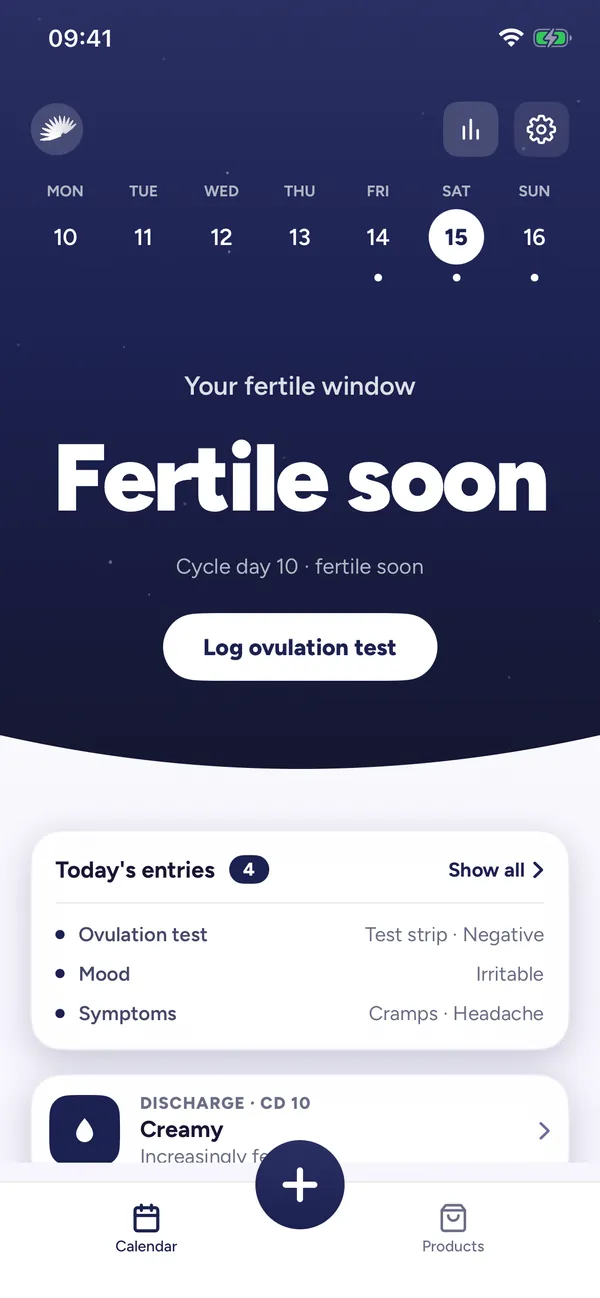
If you confirm a static smiley in Cyelle, Cyelle sets the predicted ovulation on the following day. That is a day-based calculation, not a finding. An example: your test shows the static smiley on Tuesday morning, and Cyelle sets the predicted ovulation on Wednesday. Actual ovulation may fall on Tuesday evening, on Wednesday or, less often, on Thursday, because the surge may have begun before the test. That is why Cyelle marks Wednesday as a prediction.
By “fertile window,” Cyelle means a calculated period of several days that ends on the predicted ovulation day (with a confirmed positive test, one day after the predicted ovulation day) and is marked in color in the calendar. A smiley does not shorten this window.
The smiley says what the test shows, not what has already happened in the body.
Trying to conceive?
A static smiley shows the LH surge that usually comes before ovulation; it says nothing more than that. A pregnancy is possible in the days before ovulation and on the day of ovulation itself, not just on a single day: sperm usually survive 3–5 days, and the egg can be fertilized for only about a day.
Health organizations suggest sex about every one to three days when you are trying to conceive, without a test having to set the schedule.
Many women test for several cycles until they know their pattern. You are also allowed to take a break if testing wears you out. A smiley says nothing about whether you are doing something right or wrong.
How long does it stay on?
With the purple test, the static smiley stays on the display for 48 hours according to the package insert. In that time the holder cannot read another test. The result appears after 5 minutes; the empty circle and the flashing smiley stay on for 8 minutes.
The pink test has no 48-hour display. The result appears within 3 minutes and stays readable for about 8 minutesutes. If you missed it: when the display is blank but the stick is still inserted, eject it (ejecting means releasing the stick from the holder, not throwing it away; the package insert shows how). The result then appears again within 2 minutes. Never put a stick back in once you have taken it out. If the result is no longer visible, don’t log anything, because you didn’t actually read a result. The “48 hours” that sometimes come up for the pink test as well are not a display time there.
You read the display only. According to the package insert, the blue stripes on the stick have no meaning with the pink test, and with the purple test too the result is not on lines on the stick.
Smiley two days in a row?
If you see the static smiley on two or more days, that does not automatically mean there were several surges. There are three common reasons.
- The display keeps running (purple only). The static smiley stays on for 48 hours. If you look at the display on two days, you see the same display twice. That is one surge, not two.
- The surge continues. In about 6 out of 10 women, LH does not rise abruptly but slowly over two to six days; that is why a test can respond on several days in a row. If you take a pink test with a new stick on the following days, it may therefore show a static smiley again. There is no manufacturer statement on this; it is an explanation from physiology.
- The time of day varies. The LH level in urine changes over the course of the day, so tests taken at different times can come out differently.
With the purple test, you log the day you tested, because the second day only shows the same display. With the pink test, you log every test you took. If the smiley stays on longer than 48 hours with the purple device, that is a question for the manufacturer’s customer service, whose number is in the package insert.
Cycle and pregnancy in one app.
Cyelle accompanies your cycle, your wish to conceive and your pregnancy. You decide at any time which module fits right now.
Try it free for 3 days. Then a monthly or yearly subscription, both modules included.
Purple and pink compared
Both tests show the static smiley, but they get there differently. The displays at a glance:
- Purple (Clearblue Advanced): empty circle, flashing smiley, static smiley. The flashing smiley shows an estrogen rise, not LH.
- Pink (Clearblue Digital): empty circle and static smiley. There is no flashing.
The purple test checks your urine for two hormones and compares them with your own baseline. In about 8 out of 100 women whose smiley had flashed, no static smiley followed in the tested cycle according to the package insert. If it appears on the very first test day without flashing, the estrogen rise may have been close in time to the LH surge.
The pink test checks LH only, with a fixed threshold.
When should you start testing?
When you start depends on your cycle length. Both package inserts contain a table; with the purple test, for a 27-day cycle you start on cycle day 7. If your cycle varies, the shortest of the last six cycles (purple) or months (pink) counts. If you don’t know your length, you first track one cycle. If you start too late, the surge may be over; if you start too early, the box may run out before the surge; with the pink test, you may then need a new box.
With the purple test, you always use the first urine after your longest stretch of sleep. With later urine, unexpected results can appear according to the package insert. With the pink test, you can test at any time of day, but at the same time every day. With both: drink normally and have gone at least 4 hours without urinating beforehand.
If the device shows an error symbol, the test did not work properly. In that case, don’t log anything. Depending on the symbol, a new stick is enough, or you need a new box with a fresh test holder; the package insert describes each symbol.
A test shows you a display. What it means for your cycle remains a calculation.
Keep testing after the smiley?
Purple: after the static smiley, according to the package insert, you do not take another test in this cycle. If you keep testing, the device shows the “New cycle” symbol. The symbol also appears if you have gone three days or longer without a test.
Pink: with the static smiley, you don’t have to keep testing. Another test is technically possible only once the display has disappeared from the screen.
Additional tests in the evening or with a different test can turn out contradictory, because the LH level in urine varies over the day and tests can have different thresholds. That is not a fault and says nothing about you. If you keep testing anyway, log every test with the time.
Cycle and pregnancy in one app.
Cyelle accompanies your cycle, your wish to conceive and your pregnancy. You decide at any time which module fits right now.
Try it free for 3 days. Then a monthly or yearly subscription, both modules included.
Common reading problems
- Strips and Clearblue show different things. A test strip and a digital device can have different thresholds and are read at different times of day. Log both results the way you read them.
- Smiley in the morning, empty circle later. The LH level in urine varies over the day. A later empty circle does not make the earlier smiley invalid.
- Two static smileys in one cycle. An earlier surge that is not yet followed by ovulation does happen. Log both; you don’t have to work out which one was the “real” one.
- The smiley has been flashing for days (purple). According to the package insert, that can last several days. If it flashes for more than 9 days although you started on the right day, the package insert says you can stop testing. Keep logging what the display shows.
- You missed the result with the pink test. After about 8 minutesutes it is gone. If the stick is still inserted, eject it, and the result is back on the display within 2 minutes. Otherwise don’t log anything, because you didn’t read a result.
- You’re not sure whether the smiley is flashing or static (purple). A flashing smiley goes on and off; a static one stays lit. Log exactly what you see.
A missing smiley, or one that stays on, doesn’t mean you did anything wrong.
If no smiley appears
Not every cycle shows every step on the device. According to the package insert, the LH surge may be too small to be shown, a test may have been missed, or no ovulation occurred in this cycle. Ovulation without a static smiley beforehand is possible, because a surge between two tests can also go unnoticed, with devices as with test strips. Not every woman feels ovulation; whether and when it happened cannot be said for sure at home.
If your test shows no static smiley in three cycles in a row, the package insert of both tests advises talking to your doctor.
The package inserts name situations in which results can be misleading: if you are pregnant or were recently pregnant, are in menopause, or take fertility medications that contain LH or hCG. The list in the package insert is longer. Read it in full before the first test, and ask your ob-gyn’s office beforehand if you take medications or have a known condition. If you are having fertility treatment, your clinic determines the schedule, and a smiley does not replace checks there. If you recently stopped the pill or another hormonal method, your cycle may be irregular for a while; both package inserts advise waiting for two natural cycles first and noting their length.
If you were recently pregnant, including a miscarriage, the package insert of the purple test advises waiting two cycles before you test. You can ask your ob-gyn or your midwife about this.
Cycle and pregnancy in one app.
Cyelle accompanies your cycle, your wish to conceive and your pregnancy. You decide at any time which module fits right now.
Try it free for 3 days. Then a monthly or yearly subscription, both modules included.
Logging it in Cyelle
In Cyelle you log the smiley yourself: you read the display and enter what it shows. Cyelle saves your entry, without a photo and without any assessment.
If you confirm a positive test, Cyelle sets the predicted ovulation on the following day and aligns the calculated window with it.
How to log the smiley
In the cycle module:
- Open the “What would you like to track?” sheet and choose the “Ovulation test” tile.
- Under “Which test?” choose the digital test, not the test strip.
- Under “Which test are you using?” choose “Clearblue Digital” (pink) or “Clearblue Advanced” (purple).
- Choose the result your display shows: empty circle, flashing smiley (purple only) or static smiley.
- Set the time, now or backdated, and save. Several tests a day are possible, each with its own time.
Not a method of birth control
A static smiley is not a method of birth control, and Cyelle is not a method of birth control. Neither the calculation nor observation nor a test is suitable for that. The test only responds once the surge is already under way, and sperm survive several days, usually 3–5, in individual cases up to 7. A pregnancy is therefore also possible on days before the smiley.
The same applies after the smiley, with an empty circle or with an error symbol: no day can be ruled out by a test or an app. You can talk about birth control with your ob-gyn or another health care provider.
Frequently asked questions
What does the static (solid) smiley face on Clearblue mean?
The static (steady, constant, non-flashing) smiley shows that the test has picked up a rise of the hormone LH in your urine. It does not show that ovulation has already happened, and it does not assess you. It is not a pregnancy test either: the test checks for LH, not hCG.
When is ovulation after the static smiley?
According to the package insert, about 24–36 hours after the surge begins. Because the smiley only appears once the surge is already under way, ovulation usually follows within about a day after the smiley, and for some women up to two days later. Other expert sources give about 20 hours from the first positive urine test. These are ranges from many women, not an appointment for you.
How long does the static smiley stay on?
With the purple test (Clearblue Advanced), 48 hours, and in that time the device cannot read another test. With the pink test (Clearblue Digital), the result stays readable on the display for about 8 minutesutes.
Why did I get a static smiley two days in a row?
With the purple test, the 48-hour display keeps running; it is the same display. With the pink test, a new stick on the following day can show a smiley again, because for many women the surge lasts several days.
Does the static smiley show a pregnancy?
No. The test checks for LH, not the pregnancy hormone hCG. Whether hCG is in your urine is shown by a pregnancy test. The package inserts even list a current or recent pregnancy as a situation in which results can be misleading.
Static smiley but no ovulation: is that possible?
Yes, it is possible. The smiley shows the surge that usually comes before ovulation, but does not prove it. With test strips that have a lower threshold, in about 3 out of 10 cycles there was an earlier surge that was not yet followed by ovulation. Whether and when ovulation happened cannot be said for sure at home; a doctor can look into that.
Should I keep testing after the static smiley?
According to the package inserts, no further test is needed in this cycle. With the purple device, another test shows the “New cycle” symbol. If you want to test anyway, log every test with the time.
Is the smiley suitable for birth control?
No. The smiley, the calculation and observation are not suitable for birth control. Sperm survive several days, and a pregnancy is possible even before the smiley.
When to get medical advice
These signs need medical attention:
- Sudden, severe pain in the lower abdomen, especially on one side, with dizziness, fainting, nausea, very pale skin or shoulder pain, or heavy bleeding: call 911 (or your local emergency number) right away.
- One-sided pain in the lower abdomen when your period is late or or with bleeding or brownish discharge (even light), if you could possibly be pregnant: get checked in the emergency room (ER) right away.
- No static smiley in three cycles in a row: talk to your ob-gyn.
- Your period is absent for more than three months, or your cycles are repeatedly shorter than 24 or longer than 38 days: talk to your doctor.
- Trying to conceive without getting pregnant despite regular sex without birth control: talk to your doctor after 12 months if you are under 35, after 6 months from age 35, and without waiting from age 40. You are welcome to ask sooner at any time, for example if your cycle is very irregular.
For orientation only — no substitute for medical advice or diagnosis.
All values are calculations. Cyelle is not a contraceptive and does not provide diagnoses.