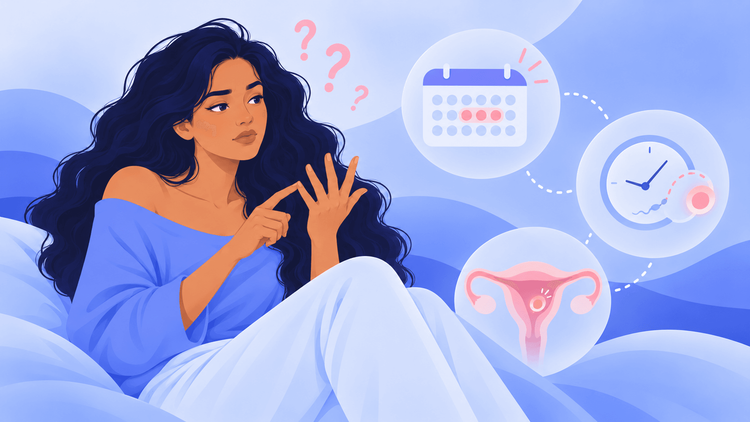
How long it takes to get pregnant can’t be predicted: up to a year counts as a normal wait, which is about twelve cycles, and most pregnancies happen within the first six months.
Several cycles without a pregnancy, called TTC cycles in online forums (TTC stands for “trying to conceive”), are common and on their own are not a sign that something is wrong. From age 35, doctors usually recommend an evaluation after about six months. There are separate sections on the time after a miscarriage or a D&C (dilation and curettage); if you haven’t had one, skip them.
At a glance
- Normal wait
- up to 1 year
- One year is about
- 12 cycles
- Check after, from 35
- 6 months
How long does it take?
Medically, a year counts as a normal wait before you get pregnant if you have regular sex without birth control.
There’s a biological reason it doesn’t work every cycle. A pregnancy is most likely in a window of about six days that ends at ovulation: sperm can survive for up to five days, and the egg can be fertilized for only about 12–24 hours after ovulation. Ovulation shifts by a few days from cycle to cycle, so the window can only be calculated as a range of time. That means you can’t work out days on which a pregnancy is ruled out: calculation and observation are not suitable for birth control.
Pregnant at 30, 35 or 40
How quickly you get pregnant also depends on age: the chance per year goes down. Depending on the analysis, out of 100 women who have regular sex without birth control for a year, the following number get pregnant:
- at 30: about 75–80
- at 35: about 65–75
- at 40: about 45–55
These are averages across many women, not a statement about you. For women under 40, more than 8 in 10 couples get pregnant within a year and more than 9 in 10 within two years. Even in your late 30s and at 40, a longer wait doesn’t mean it won’t happen.
What is a TTC cycle?
In forums for people trying to conceive, you’ll see “TTC cycle” for a cycle in which you’re trying to get pregnant. “On my 4th TTC cycle” or “cycle 4 of TTC” means the fourth cycle since the wish began. You’ll also see CD for cycle day (CD 1 is the first day of your period) and the two-week wait, or TWW: the wait until a pregnancy test. These are forum shorthand, not medical terms.
The term isn’t medical, and many people don’t like the idea of a cycle as an “attempt,” especially after a loss; this article therefore mostly says “cycle.” A cycle counts from the first day of your period to the day before the next one. When you talk to your doctor, what counts is the number of months and your age, not the cycle number.
How many cycles are normal?
There is no fixed number of TTC cycles that counts as normal, because it depends on whom an analysis includes. Depending on the analysis, about 6 to 8 in 10 women are pregnant after six cycles and about 75 to 90 in 100 after twelve. The higher values come from women who tracked their cycle and timed sex deliberately; they are more likely upper limits.
So after six cycles, about 2 to 4 in 10 women are still not pregnant. If you’re still waiting in your third or sixth cycle, you’re part of a large group.
The number of cycles says nothing about you.
How often to have sex?
To get pregnant, health experts don’t name a single day but a rhythm: sex every 2 to 3 days throughout the whole cycle, or every 1 to 2 days in the days around ovulation. More often isn’t worse, and there’s no need to hold back or save up. Because the window is about six days long, you don’t have to hit the exact day of ovulation. There is no evidence for any particular position or for lying down for a long time after sex.
When sex by the calendar becomes an obligation, it can weigh on both of you, your partner too. Talk about it.
Stress and trying to conceive
It isn’t firmly established that everyday stress alone prevents a pregnancy, and “just relax” isn’t advice but a line that leaves people feeling guilty. Watching your cycle closely can itself cause stress. If planning becomes a burden, choose the path that feels right to you, even one with less planning.
Cycle and pregnancy in one app.
Cyelle accompanies your cycle, your wish to conceive and your pregnancy. You decide at any time which module fits right now.


Try it free for 3 days. Then a monthly or yearly subscription, both modules included.
Do ovulation tests help?
Whether an ovulation test shortens the time to pregnancy hasn’t been settled. It’s one way to get to know your own cycle better, but not a requirement.
An ovulation test checks your urine for the hormone LH (luteinizing hormone). Its rise usually comes one to two days before ovulation. So the test shows a rise, not ovulation itself; in some cycles, a rise is not followed by ovulation. A negative result doesn’t rule out ovulation, because a short rise can fall between two tests.
Even without a test, a calculation based on your cycle length narrows things down to a window of several days, and cervical mucus usually becomes clearer and stretchier before ovulation. The calculation rarely pins down a single day: in a 28-day cycle, ovulation falls exactly 14 days before the next period in only about 1 in 10 cycles. Ovulation tests, calculation and observation are not suitable for birth control in any cycle.
When to test for ovulation?
When to take an ovulation test and how to read it, step by step:
- Work out your cycle length from several cycles you’ve counted yourself. If it varies, use the shortest of your last six cycles. If you don’t know it yet, log your next periods; until then you can go without a test.
- Check the package insert for which cycle day to start on; if it names a different day than here, follow the package. For classic test strips, one patient guide from German gynecologists names roughly cycle day 9 for a 28-day cycle and roughly day 14 for a 35-day cycle; digital tests give different start days depending on the product.
- Follow the insert on time of day and on how much to drink; it differs from test to test, for example on whether first morning urine works. Always test at about the same time of day. A single test a day can miss a short rise; some people test twice a day if the insert allows it, and then need more tests.
- Read the line only within the stated time. With test strips, a result counts as positive if the test line is at least as dark as the control line; the control line only shows that the test is working, and if it’s missing, the test is invalid. That is a manufacturer convention, not a medical threshold. A lighter line stays negative, even if it gets darker than the day before; how dark it is says something about the line, not about you.
- Note the date, time and what you see.
- Positive means: a rise in LH is displayed. Ovulation usually follows within one to two days, but it can be delayed or not happen. A positive test does not end the window. If the test stays positive on consecutive days, that is usually counted as the same rise; in some women the line gets dark several times in the same cycle.
Digital tests show symbols. On Clearblue purple (Advanced), the empty circle stands for no clear rise above your baseline, the flashing smiley for an estrogen rise and the static smiley for an LH rise. The flashing smiley can appear on several days in a row and is not yet an LH rise; the static smiley stays on for about two days, which is also the same rise. Clearblue pink (Digital) has only the empty circle and the static smiley. If no static smiley appears in a cycle, the rise may have fallen between two tests. The insert advises seeing a doctor after three cycles in a row without a displayed LH rise; that is a note from the package, not a medical deadline.
The line tells you about the test, not about you.
When should you see a doctor?
In the US, the usual advice is this: if it hasn’t worked after about a year of regular sex without birth control, it’s best to have it looked into by a doctor, at an ob-gyn’s office or a fertility clinic. From age 35, that applies after about six months. From age 40, you can also make an appointment without waiting first; in the UK, guidelines refer women aged 36 and over at their very first appointment. An appointment also makes sense sooner with known pre-existing conditions, with very irregular or missed periods and after several miscarriages. You don’t have to wait until the last day of the time frame.
Two people are always involved in a pregnancy, and the causes can lie with one or both. That’s why both are usually examined: for the woman, usually a discussion of her cycle and medical history, an ultrasound and blood tests; for the man, a semen sample (semen analysis), which often makes sense early on.
Coverage for fertility treatment depends on your state and your health plan, and plans can set conditions, such as age. An age limit in a plan concerns coverage, not whether a pregnancy is possible. Ask your health plan early.
It helps to have these details ready for the appointment:
- the first days of your last periods, cycle lengths and how long you bleed
- how long you’ve been trying and how often you have sex
- test days and results, if you tested
- pre-existing conditions, medications and earlier pregnancies or miscarriages
Cycle and pregnancy in one app.
Cyelle accompanies your cycle, your wish to conceive and your pregnancy. You decide at any time which module fits right now.
Try it free for 3 days. Then a monthly or yearly subscription, both modules included.
What you can do beforehand
To prepare for pregnancy, medical organizations recommend that women who want to conceive take at least 400 micrograms (mcg) of folic acid daily as a supplement, ideally starting four weeks before pregnancy. Smoking can affect fertility in women and men, and with alcohol, avoiding it is the safest approach. Talk about medications with your provider’s office or your pharmacist. This is about preparing, not about shortening the wait.
After the pill or an IUD
After the pill or an IUD, the wait begins when the effect ends and you have regular sex without birth control. After you stop the pill, ovulation can return as early as the first cycle; it can take up to about three months until your period returns to a familiar rhythm. After an IUD or implant is removed, fertility usually returns quickly. After the three-month birth control shot, it often takes longer: fertility often returns only after about a year, and for some women later. The insert of Clearblue purple (Advanced) notes that cycles can be irregular after stopping hormonal birth control and suggests waiting two cycles before testing.
Irregular cycles
If your cycles vary a lot, the calculated window becomes wide, and the calculation tells you little. Health experts then name the same rhythm across the whole cycle, without you needing to know when you ovulate: sex every 2 to 3 days. Ovulation tests need more test days and can turn positive several times without ovulation following.
With longer cycles you have fewer tries in a year, so count in months. It’s worth seeing a doctor sooner than after a year if your cycles are repeatedly shorter than 24 or longer than 38 days, or if your period stays away for more than three months; take a pregnancy test first.
Asking sooner isn’t overreacting.
Second child, treatment
Second child: The time is counted from when you started trying again, and you are a different age now than with your first child. Questions about breastfeeding and your first cycle after birth are something to discuss with your ob-gyn or midwife.
Fertility treatment: The numbers in this article describe couples without treatment. What your clinic tells you about sex, tests and when to take a pregnancy test takes priority.
Surviving the two-week wait
The time between ovulation and a pregnancy test often lasts about two weeks, the two-week wait, and for many it is the hardest part. A pregnancy test gives the most reliable result from the first day of a missed period. Early pregnancy tests sometimes show something a few days earlier, but a negative result before then doesn’t rule out a pregnancy. If your period doesn’t come, repeat the test after a few days. If you don’t know when your period is due, test no earlier than 21 days after the last time you had sex without birth control.
If the test is positive, make an appointment with your ob-gyn’s office. If a loss was only a few weeks ago, a positive test can still be left over from the loss. A positive test together with pain on one side of the lower abdomen, shoulder pain or dizziness means you should go to the emergency room (ER) right away, with or without bleeding. If you have bleeding with a positive test but no severe pain, call your ob-gyn’s office today (after hours, call the same number; there’s usually someone on call; if you don’t have an ob-gyn yet, call your health plan’s nurse line). More on this in the box at the end.
Waiting can be hard. If it helps to talk, ask your provider’s office about counselors or support groups for people struggling to conceive.
Tracking in Cyelle
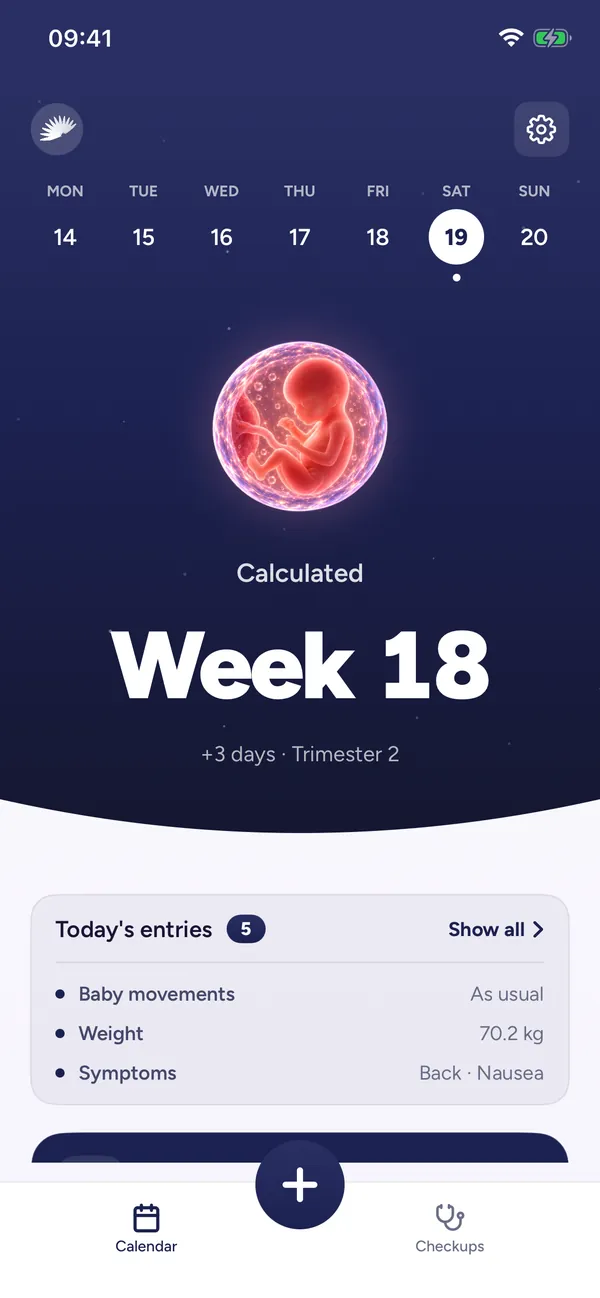
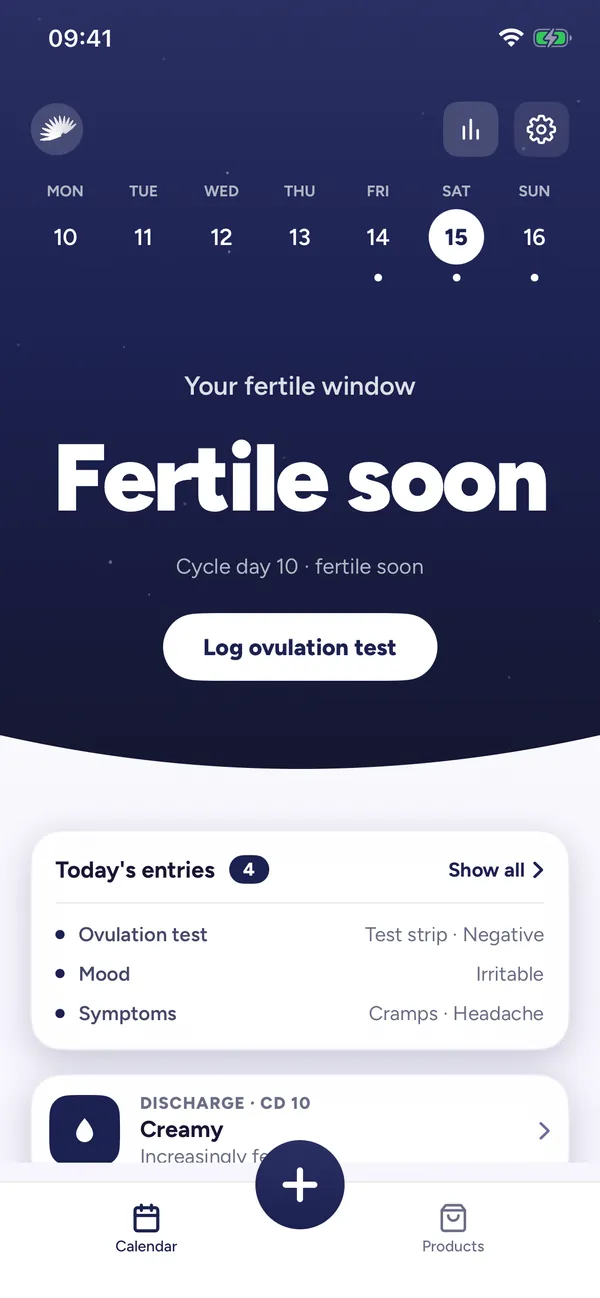
This article appears on the blog of Cyelle, a cycle and pregnancy app for iPhone and Android. There you log your period, ovulation tests, sex and symptoms. You read a test yourself and enter what it shows, including several tests a day with the time; the app saves what you enter, without a photo.
Cyelle shows the fertile window as a calculated period of time and ovulation as a prediction, not a fact. The app also shows how reliable the prediction is; from three logged cycles on, Cyelle calculates with your own cycle length. The app is not a contraceptive and gives no diagnosis. Cyelle doesn’t sell your entries, and you can delete them yourself in the app.
Cycle and pregnancy in one app.
Cyelle accompanies your cycle, your wish to conceive and your pregnancy. You decide at any time which module fits right now.
Try it free for 3 days. Then a monthly or yearly subscription, both modules included.
After a miscarriage
This section is for women who have had a miscarriage, and it applies mainly to early miscarriages in the first 12 weeks of pregnancy. If you haven’t had one, skip it. It’s okay if even a very early loss hurts, and it’s understandable if you don’t yet know whether or when you want to try again. Early miscarriages are mostly caused by random changes in the chromosomes and, as a rule, can’t be prevented. Nobody did anything wrong.
There is no medically based minimum waiting time. As soon as you feel ready and a cycle with ovulation takes place, a new pregnancy is possible. A miscarriage doesn’t tell you how it will go next time; how the wait changes differs from woman to woman. Talk through any worries about this with your provider. The numbers above describe how long it takes to get pregnant, not whether a pregnancy lasts.
Sometimes only a follow-up ultrasound shows that a pregnancy isn’t developing. Waiting, pills and a D&C are options depending on the situation; which path suits you, you decide with your provider. If you are Rh-negative, a blood type factor listed in your prenatal records or blood test results, ask early at your ob-gyn’s office about the Rh immune globulin (anti-D) shot.
Trying again after a loss
After a miscarriage, earlier recommendations suggested waiting six months; more recent analyses see no physical reason to wait after early miscarriages. That doesn’t show that sooner is better, and it’s no reason to rush you: couples grieve at different paces. If your provider gave you a waiting time, ask for the reason.
After an ectopic pregnancy (the pregnancy is located outside the uterus) or a molar pregnancy (a rare abnormal development of tissue), your provider sets the timing.
You don’t have to be rushed.
First cycle after miscarriage
When the pregnancy ends on its own, whether you wait it out or take pills, there is bleeding like a period or heavier, along with cramps, which can last up to three weeks, in some cases longer. This bleeding is not a period. Pads, tampons and menstrual cups are all possible; pads help you judge the amount. A follow-up ultrasound after seven to fourteen days is common, because remaining tissue can pass with the next period or may need further treatment.
A “break cycle,” meaning one cycle of rest before the next attempt, isn’t necessary after a natural course. Your first period usually comes after five to six weeks, though it can be delayed considerably. Ovulation can return before then: in individual cases after 8–10 days, in 9 of 10 women within a month. A new pregnancy is therefore possible even before the first period. If you don’t want to get pregnant in the coming weeks, talk about birth control at your follow-up visit, because calculation and tests are not suitable for it.
Recommendations on sex differ: a German patient guide sees no reason to hold off, while UK sources advise waiting until the symptoms are over. There is no point at which you have to want to. The signs that need medical help are listed in the box at the end.
Getting pregnant after a D&C
In a D&C (dilation and curettage), the uterus is emptied in a short procedure, usually as an outpatient and under anesthesia, today most often by suction (aspiration). With a molar pregnancy it is necessary, otherwise not in every case; you discuss this with your provider.
After a D&C, too, there is no fixed waiting period. It can make sense to wait for one period so that the lining of the uterus rebuilds and the cervix firms up. That is a medical recommendation, not a rigid rule, and belongs in your follow-up care. Here too, ovulation can return before the first period, which usually comes after about five to six weeks; if you don’t want to get pregnant right away, bring up birth control at your follow-up.
The tissue can be examined if you want; whether your health plan covers the cost, ask beforehand at your provider’s office. If no period comes after about eight weeks, or it is very light, call your ob-gyn’s office. The signs you should have looked into by a doctor are listed in the box at the end.
Ovulation tests after loss
In the first weeks after a miscarriage or a D&C, an ovulation test can be hard to interpret. Leftover pregnancy hormone (hCG) can make the result misleading, and the cycle is often irregular, with several rises or none that is clear. That is not a defect in the test. The insert of Clearblue purple (Advanced) names a recently ended pregnancy as a circumstance in which the display can be misleading; it does not name a waiting time for this. If you’re unsure, ask your provider.
- If you want to test, take a pregnancy test first. After a miscarriage or a D&C it can stay positive for several weeks because hCG falls slowly; as long as it’s positive, an ovulation test tells you little. A negative pregnancy test after the loss makes a later positive test meaningful.
- If it’s still positive after several weeks, or turns positive again after a negative result, call your ob-gyn’s office.
- Write down the date, time and display, but don’t try to interpret every line.
Once your cycles have settled, the advice in “When to test for ovulation?” applies again. A break from tracking is always okay.
Cycle and pregnancy in one app.
Cyelle accompanies your cycle, your wish to conceive and your pregnancy. You decide at any time which module fits right now.
Try it free for 3 days. Then a monthly or yearly subscription, both modules included.
Counting after a miscarriage
The first cycle after a miscarriage begins with the first period afterward: cycle day 1 is its first day. The bleeding from the miscarriage is not a period and, if you use a cycle-tracking app, doesn’t belong in the calendar as a period. Whether you start counting anew or carry on is up to you; what matters is a consistent way of counting. Predictions are especially uncertain in the first cycles, so plan with a range of time instead of a date.
To decide when a conversation with a doctor makes sense, you don’t have to start from zero: UK guidelines (NICE) state explicitly that the time frame for evaluation doesn’t start over if the miscarriage falls within the waiting time. Keep counting the time since you began trying, and talk to your provider if something is on your mind.
After a single miscarriage, a search for a cause is generally not routine; you can raise questions and worries at any time. After two miscarriages you can ask about an evaluation, and genetic testing of the tissue then makes sense. Usually after three miscarriages, further tests may be ordered. Ask your care team what follow-up care and support is available around a loss, including from a midwife if you have one. Share Pregnancy & Infant Loss Support (1-800-821-6819, weekday office hours) offers peer support and support groups.
Every cycle with a new period can bring grief or emptiness, and fear of the next attempt or of a positive test is common after a loss. If it helps to talk, ask your care team about counselors and local support groups, or see the box below for free, confidential phone support.
If it’s hard right now
If you’re thinking about hurting yourself, call or text 988 right away; it’s free, confidential and available around the clock (information for the US). If you’re in immediate danger, call 911 (or your local emergency number) right away. For support during or after pregnancy, including after a loss, you can also call or text the National Maternal Mental Health Hotline at 1-833-852-6262. If grief takes up a large part of your life, get help early, from your provider or a counselor.
For orientation only — no substitute for medical advice or diagnosis.
Frequently asked questions
How long does it take to get pregnant?
Up to a year counts as a normal wait, which is about twelve cycles; most pregnancies happen in the first six months. Depending on the analysis, out of 100 women, about 75 to 80 are pregnant after a year at age 30, about 65 to 75 at 35 and about 45 to 55 at 40. These are averages, not a statement about you.
How many TTC cycles are normal?
There is no fixed number. Depending on the analysis, about 6 to 8 in 10 women are pregnant after six cycles and about 75 to 90 in 100 after twelve. Several cycles without a pregnancy are therefore common. When you see a doctor, what counts is the number of months and your age, not the cycle number.
What is a TTC cycle, and what is the two-week wait?
TTC stands for “trying to conceive”: in forums, women use “TTC cycle” to count which cycle of trying to get pregnant is underway. The term isn’t medical; if counting attempts doesn’t feel right to you, just say “cycle.” The two-week wait is the time between ovulation and a pregnancy test, often about two weeks.
When should I see a doctor if I’m trying to conceive?
In the US, it’s best to have it looked into after about a year without a pregnancy, after about six months from age 35, and from age 40 even without a waiting period, and sooner with known pre-existing conditions, very irregular periods or several miscarriages. Both partners are usually examined. An appointment is possible earlier at any time.
When can I get pregnant after a miscarriage or D&C?
There is no medically based minimum waiting time. As soon as you feel ready and a cycle with ovulation takes place, a new pregnancy is possible; ovulation can return before the first period. After a D&C it can make sense to wait for one period; you discuss that at your follow-up. Calculation and tests are not suitable for birth control.
Does a miscarriage reset the waiting time?
UK guidelines (NICE) say that if a miscarriage happens during the waiting time, the time frame for evaluation doesn’t start over. You can talk to your provider at any time.
When should I take an ovulation test, and can I use one after a miscarriage?
When to start testing is in the package insert and depends on your cycle length. An ovulation test shows an LH rise, not ovulation itself. Whether tests shorten the time to pregnancy hasn’t been settled; they are one way to get to know your cycle, not a requirement. After a miscarriage or a D&C, a test can be hard to interpret in the first weeks, because leftover hCG can make the result misleading. Ovulation tests and calculation are not suitable for birth control.
How often should we have sex when trying to conceive?
Health experts don’t name a single day but a rhythm: every 2 to 3 days throughout the whole cycle, or every 1 to 2 days around ovulation. More often isn’t worse, and saving up isn’t necessary. Calculation, observation and ovulation tests are not suitable for birth control.
When to see a doctor
Get help right away (information for the US):
- Fainting, collapse, circulation problems or very heavy bleeding in which a pad is soaked soon after changing it: call 911 (or your local emergency number) right away.
- A positive test or a missed period together with pain on one side of the lower abdomen or severe pain, shoulder pain or dizziness, also together with bleeding: go to the ER right away (call 911 if you feel faint or can’t get there safely).
- A fever over 100.4 °F (38 °C), foul-smelling discharge or increasing lower abdominal pain in the days after a miscarriage or D&C: go to the ER right away, or call your ob-gyn’s office right away (after hours, call the same number; there’s usually someone on call; if you don’t have an ob-gyn yet, call your health plan’s nurse line).
Call your ob-gyn’s office today (after hours, call the same number; there’s usually someone on call; if you don’t have an ob-gyn yet, call your health plan’s nurse line):
- Bleeding with a positive test or a missed period, even light bleeding, if no severe pain comes with it.
- The bleeding after a miscarriage becomes clearly heavier again after a few days, or a test turns positive again after a negative result.
Worth having checked by a doctor:
- The bleeding after a miscarriage lasts longer than about three weeks, or you’re unsure whether everything has passed.
- A follow-up after the miscarriage hasn’t happened yet, or the pregnancy test is still positive after several weeks.
- Your period hasn’t come back about eight weeks after a miscarriage.
- It hasn’t worked after about a year, after about six months from age 35, earlier from age 40; with very irregular periods, a period that stays away for more than three months, or several miscarriages, also sooner.
For orientation only — no substitute for medical advice or diagnosis.
All values are calculations. Cyelle is not a contraceptive and does not provide diagnoses.