Implantation usually happens 8 to 10 days after ovulation, and 6 to 12 days are possible. The timing varies from woman to woman and from cycle to cycle, so it’s a window, not a date.
A very sensitive early test is sometimes positive from about the 11th day after ovulation, but a test from the first day of a missed period is the most reliable. After an embryo transfer these numbers don’t apply; there’s a separate section on that further down.
At a glance
- Possible window
- DPO+6–12
- Most often
- DPO+8–10
- Test more reliable
- From period due
Implantation by DPO
Implantation is the step in which the fertilized egg attaches to the lining of the uterus. In the most important study on this, implantation was defined as the day the pregnancy hormone hCG first showed up in urine, measured with laboratory methods that are far more sensitive than a home test. In pregnancies that continued, that was 6 to 12 days after ovulation.
In 84 of 100 pregnancies that lasted at least six weeks, it was the 8th, 9th or 10th day.
The count starts at ovulation: DPO+8 is the 8th day after ovulation, often written “8 DPO” in forums. Many guides count from fertilization, which is at most about a day later. A guide that says “day 7 after fertilization” means roughly DPO+8 for you.
This is roughly how it goes:
- DPO+1 to DPO+5: The fertilized egg divides and travels through the fallopian tube to the uterus for about four days. Around DPO+5 it is a small cluster of cells.
- DPO+6: The earliest window for implantation begins.
- DPO+7 to DPO+9: The cluster of cells attaches to the lining and burrows in. From about DPO+8, hCG begins to form.
- DPO+10: The most common window comes to an end.
These are averages from research. They describe what happens in many women, not what happens to you on which day.
How long implantation takes
Implantation isn’t a moment but a process over several days: the cluster of cells attaches, burrows into the lining and is enclosed by it. Your lining has been preparing for this since ovulation. Research only measures the beginning, the first hCG. How long the process takes in you, you can’t observe.
“Usually” is meant literally. In about 16 of 100 of these pregnancies, the first hCG detection fell outside days 8 to 10, so earlier or later. Implantation at DPO+7 or DPO+11 does happen.
Cycle and pregnancy in one app.
Cyelle accompanies your cycle, your wish to conceive and your pregnancy. You decide at any time which module fits right now.


Try it free for 3 days. Then a monthly or yearly subscription, both modules included.
Ovulation day: a calculation
Counting from ovulation has a catch: you almost never know the day of ovulation for sure. By calendar it is a prediction, and even in a 28-day cycle ovulation varies over about ten days. An ovulation test also only pins it down as an approximation. The usual rule of thumb is to take the day after the first positive result as the day of ovulation. If ovulation shifts by two days, the implantation window shifts with it.
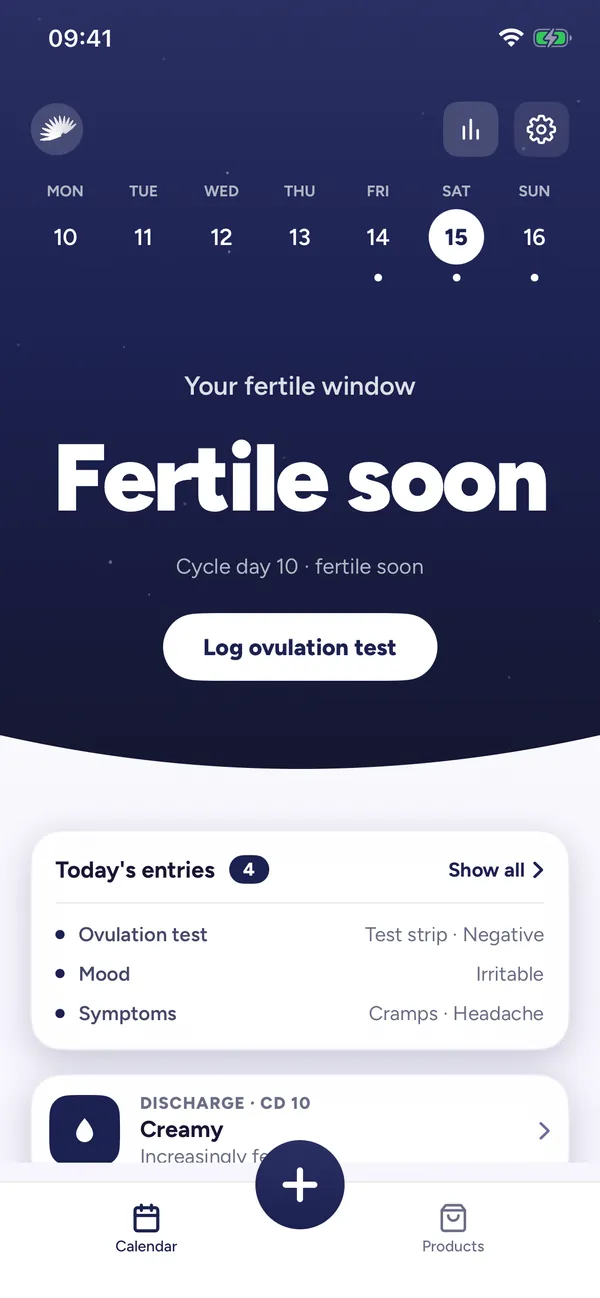
An example with an ovulation test: it is positive for the first time on Monday, so you count Tuesday as DPO+0. The implantation window then runs, by calculation, from Monday of the following week (DPO+6) to Sunday (DPO+12), most often from Wednesday to Friday (DPO+8 to DPO+10). A very sensitive early test can be positive from about Saturday (DPO+11). In Cyelle the count can differ by one day if you have confirmed a positive test: there, DPO+1 starts after the last fertile day.
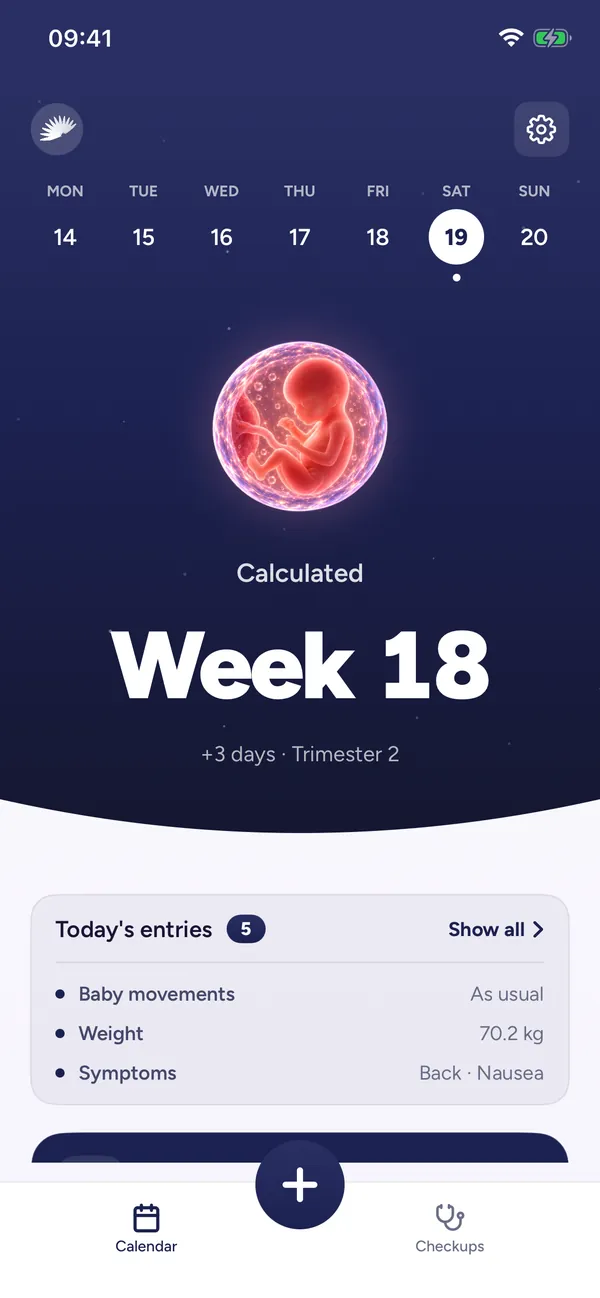
If you log your period and your tests in Cyelle, the app shows you the expected ovulation as a calculated prediction and counts the DPO days after it. That is a calculation from your entries, not a statement about what is happening in your body.
Important: This is not contraception. Neither the calculation nor observing your cycle is suitable for preventing a pregnancy.
The day of ovulation is almost always a calculation, not a date.
When is the test positive?
A pregnancy test picks up hCG in urine. It doesn’t show the implantation, but the hormone that is made afterward. That is why it stays negative for a few days after implantation: the hormone first has to build up. How much the test needs is printed on the package in mIU/mL. Early tests list about 5 to 25 there, standard tests mostly 20 to 50.
The research numbers look like this:
- DPO+8 to DPO+10: hCG is in the body, but far too little of it in the urine. A urine test is usually still negative, and a negative result then says little.
- DPO+11: A very sensitive early test can be positive.
- DPO+12 and DPO+13: A standard test is often still negative.
- From the day your period is due: A test is more reliable, but depending on the test not in every pregnancy.
Your period isn’t due at DPO+14 in every woman. The luteal phase, the time between ovulation and your next period, lasts about 7 to 17 days depending on the woman. When your test is first reliable therefore depends on your own luteal phase. That is the reason for the rule to test from the first day of the missed period.
Even on that day, not every pregnancy can be detected. In about 10 of 100 pregnancies, hCG can’t yet be detected on the first day of the missed period even with a laboratory test. A week later, hCG can be detected in about 97 of 100 pregnancies. With a home test, on the day of the period it is fewer, depending on the test and brand about 54 to 97 of 100. This is often down to the timing of implantation and the sensitivity of the test, not to you.
What this means for testing
If you test early and the result is negative, the test doesn’t pick up hCG yet. That doesn’t rule out a pregnancy, and it doesn’t confirm one either. After the day your period was due, a negative can also mean that it didn’t work out this cycle. Test again after two to three days, because hCG rises quickly in early pregnancy. If your period doesn’t come and the second test is negative too, talk to your ob-gyn’s office.
Calculating the window
You can work out a calculated window for your test in three steps. It remains an estimate, but it helps while you wait.
- Take the day you think you ovulated as DPO+0. That can be a calculated day or the day after a first positive ovulation test.
- Count forward 6 to 12 days. That is the window in which a fertilized egg can implant, most often on days 8 to 10.
- Keep counting to the day your period is expected. Until then a urine test often shows nothing yet. From the first day of the missed period it picks up hCG more reliably, but depending on the test not in every pregnancy.
An assumed example: in a 28-day cycle, the rule of thumb “cycle length minus 14” gives cycle day 14, Cyelle calculates with day 15, and the example assumes day 15. The implantation window then lies, by calculation, at cycle day 21 to 27, most often at cycle day 23 to 25. In weeks of pregnancy, which are counted from the last period, that is by calculation 2 weeks, 6 days to 3 weeks, 5 days. In everyday terms: by calculation, implantation falls in the 3rd to 4th week of pregnancy, because at 3 weeks plus some days you are in your 4th week. With a luteal phase of 14 days, the expected period would be on cycle day 29, the first day of the next cycle. With a longer or shorter cycle everything shifts, because ovulation comes later or earlier.
If you calculate from an uncertain day of ovulation, the window can slip by several days in either direction. If ovulation is unknown or your cycle is irregular, only a rough range is left of the calculation. Then the day of the missed period is the most reliable point in time. If that is unclear too, a common rule of thumb is to test no earlier than about three weeks after the possible time. Follow the instructions on the package, including the reading time.
Test earlier and you get an answer earlier, but not necessarily a reliable one.
Feel or see implantation?
It hasn’t been shown that implantation reliably makes itself felt. Twinges in the lower abdomen, breast tenderness or tiredness also occur in the second half of the cycle without pregnancy. They can’t be told apart, and nothing follows from them alone. That applies both ways: someone who notices nothing can still be pregnant, and someone who notices something isn’t necessarily. If you read meaning into every twinge while you wait, that’s understandable.
Bleeding isn’t a reliable sign of implantation either. In one study, only about 9 of 100 pregnant women whose pregnancy lasted at least six weeks bled in the first eight weeks, and mostly around the day their period was expected, not on the day of implantation. Light bleeding therefore can’t be read as a sign of implantation. If bleeding comes along with a positive test, call your ob-gyn’s office right away; more on this in the box at the end.
Twinges and breast tenderness also occur in the second half of the cycle without pregnancy.
Late implantation
If implantation happens after DPO+10, many people talk about “late implantation”. That is a statement about timing, not a diagnosis. A test then turns positive correspondingly later. More often, a late test is down to a later ovulation or a longer cycle.
You can neither observe nor influence the timing, and it says nothing about whether you did anything right or wrong. How the pregnancy develops is something your ob-gyn’s office clarifies.
After a very early loss
This section is about an early loss. Read it if you like.
A pregnancy can end very early, even shortly after a positive test, without anyone being to blame. If this affects you or the wait weighs on you, that’s understandable, especially after several cycles. You can talk to your ob-gyn’s office or a midwife at any time. In the US, Share Pregnancy & Infant Loss Support is one place to turn to for a conversation after a loss; your care team can also tell you about local support groups.
Cycle and pregnancy in one app.
Cyelle accompanies your cycle, your wish to conceive and your pregnancy. You decide at any time which module fits right now.
Try it free for 3 days. Then a monthly or yearly subscription, both modules included.
After an embryo transfer
After fertility treatment with an embryo transfer, the numbers in this article don’t apply. The schedule depends on the day the embryo was transferred, and your fertility clinic will tell you the day to test. Follow that guidance.
If you were given an hCG injection to trigger ovulation or before an insemination, that hormone can, depending on the medicine and dose, be detectable in urine for up to about two weeks and make a test positive even though you aren’t pregnant. Ask your provider from which day a test is reliable.
Positive test: What now?
Call your ob-gyn’s office and make an appointment. That is where the pregnancy is confirmed and dated. You don’t always get an appointment right away, so get in touch early. If you’d like a certified nurse-midwife to care for you during pregnancy, you can start looking now. Bleeding or pain won’t wait for the appointment; see the box at the end.
The key points
Implantation usually happens 8 to 10 days after ovulation, and 6 to 12 days are possible. You can’t see it, can’t reliably feel it and can’t calculate it to the day, and the calculation is not contraception. A pregnancy test only picks up the hCG made afterward. It is most reliable from the first day of the missed period, but depending on the test not in every pregnancy. After a negative result, a second test after two to three days is worthwhile.
Frequently asked questions
How many days after ovulation does the egg implant?
Usually 8 to 10 days after ovulation. 6 to 12 days are possible. In 84 of 100 pregnancies that lasted at least six weeks, the first hCG detection fell on day 8, 9 or 10.
How long does implantation take?
Implantation is a process over several days in which the fertilized egg attaches and burrows into the lining. Research only measures the beginning through the first hCG. How long the process takes in you can’t be observed.
When can a test turn positive after implantation?
That depends on the hCG in the urine. At DPO+8 to DPO+10 a urine test is usually still negative; a very sensitive early test can be positive from about DPO+11. From the first day of the missed period a test is more reliable. Even with very sensitive laboratory tests, hCG can’t yet be detected on that day in about 10 of 100 pregnancies, and a home test picks up even fewer, depending on the test.
Can you feel or see implantation?
That implantation makes itself noticeable as a particular feeling or as bleeding hasn’t been shown. Twinges, breast tenderness or tiredness also occur in the second half of the cycle without pregnancy. In one study, only about 9 of 100 pregnant women whose pregnancy lasted at least six weeks bled in the first eight weeks, mostly around the day their period was expected.
What does late implantation mean?
Implantation after DPO+10 does happen. That is a statement about timing, not a diagnosis, and you can’t observe it. A test then turns positive correspondingly later. How the pregnancy develops is something your ob-gyn’s office clarifies. If you’re worried, a conversation there helps.
On which cycle day does the egg implant?
That depends on ovulation. As an assumed example: if the assumed ovulation in a 28-day cycle falls on cycle day 15, the window lies, by calculation, at cycle day 21 to 27, in weeks of pregnancy at 2 weeks, 6 days to 3 weeks, 5 days, so in the 3rd to 4th week. That is about 2 to 8 days before a period that, with a luteal phase of 14 days, would be due on cycle day 29, most often 4 to 6 days before. With a different cycle length, everything shifts.
When does implantation happen after an embryo transfer?
That depends on the day of the transfer and the developmental stage of the embryo. The numbers for natural implantation don’t apply. Your fertility clinic will tell you the test day.
Can I use the implantation window as birth control?
No. Neither the calculation of ovulation nor the implantation window nor observing your cycle is suitable for preventing a pregnancy. The numbers describe what happens in many women and don’t apply to a single day for you.
When to get medical help
Get help right away (US information):
- You faint, collapse, feel very dizzy, sick or cold, or you are noticeably pale and weak: Call 911 (or your local emergency number) right away and don’t stay alone.
- With a possible or confirmed pregnancy you have severe pain in the lower abdomen or the shoulder, with or without bleeding: Go to the ER right away. If the pain comes with bleeding, or you can’t get there safely, call 911 (or your local emergency number). Don’t drive yourself.
- With a possible or confirmed pregnancy the bleeding is as heavy as a period or heavier: Go to the ER right away.
- The test is positive and you are bleeding, even lightly: Call your ob-gyn’s office right away. After hours, call the same number, as there’s usually someone on call. If you can’t reach anyone, go to the ER.
- The test is positive and you have one-sided lower abdominal pain, pain when urinating or having a bowel movement, or brownish, watery discharge, even if the pain isn’t severe: Call your ob-gyn’s office right away. After hours, call the same number, as there’s usually someone on call. If you can’t reach anyone, go to the ER.
- You have a fever with chills along with the bleeding: Go to the ER right away.
- Tissue or clots pass: Go to the ER right away.
Severe pain or heavy bleeding in early pregnancy can have many causes, some of them dangerous. Only a doctor can determine what’s behind it.
It’s best to have this checked by a doctor:
- The test is negative, but your period still doesn’t come: Test again after two to three days. If the second test is negative too, make an appointment with your ob-gyn’s office in the next few days.
For orientation only — no substitute for medical advice or diagnosis.
All values are calculations. Cyelle is not a contraceptive and does not provide diagnoses.