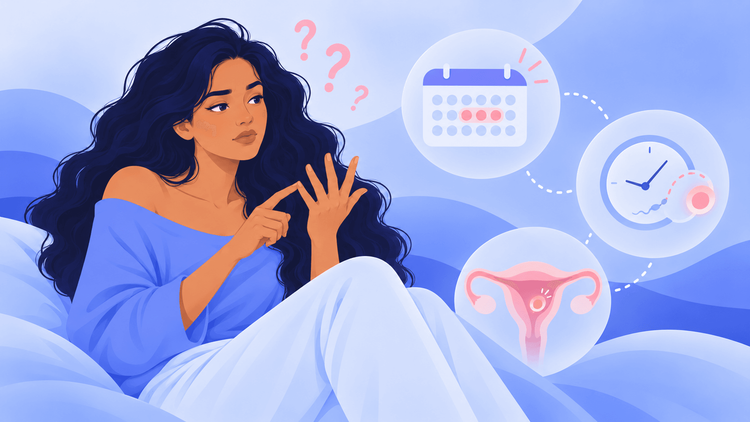
Implantation bleeding, meaning bleeding caused by the egg implanting, is not proven. In one careful study, only about 9 in 100 pregnant women bled at all in the first eight weeks, mostly around the day their period was due. That’s why bleeding doesn’t show that you’re pregnant, and if you don’t bleed, that doesn’t rule out a pregnancy.
If your test is positive or your period is late and you’re bleeding, call your ob-gyn’s office today. If you have heavy bleeding, severe pain or shoulder pain, go to the ER right away. If you faint or feel very dizzy, call 911 (or your local emergency number) right away (US information).
At a glance
- Implantation
- 6–12 DPO
- Test useful from
- Period due day
- Bleeding by week 8
- 9 in 100
- Implantation pain
- No evidence
Is it a myth?
The idea sounds plausible: the fertilized egg burrows into the uterine lining, and that causes a little bleeding. You read about it in guides and forums, and health websites list it as a possible cause of light bleeding. Hardly anyone has tested it, because you’d need to know when implantation happened.
One research team tested this: they compared the estimated time of implantation with the days on which the women bled. They found no sign that implantation causes bleeding.
That isn’t final proof, which is why “not proven” fits better than “disproven.” If your ob-gyn or midwife uses the term implantation bleeding, they don’t mean anything wrong by it, even though the link isn’t proven.
And if you bled and you’re pregnant: your bleeding was real. The only thing that’s not proven is that implantation was the reason. Two statements therefore hold in every case:
- Bleeding is not a sign of pregnancy.
- If you don’t bleed, that doesn’t speak against a pregnancy.
How common is it, really?
There is no reliable figure for how often implantation bleeding happens, because the link isn’t proven. What was observed was bleeding overall: about 9 in 100 of the women whose pregnancy lasted at least six weeks after the last period bled on at least one day in the first eight weeks. Pregnancies that ended earlier aren’t included. The bleeding mostly came around the time the period would have been expected, rarely on the day of implantation.
The 9 in 100 say nothing about what your bleeding means. If you come across a different number online, it helps to ask how long people were observed and whether every bleed was counted.
Cycle and pregnancy in one app.
Cyelle accompanies your cycle, your wish to conceive and your pregnancy. You decide at any time which module fits right now.


Try it free for 3 days. Then a monthly or yearly subscription, both modules included.
When does implantation happen?
Implantation itself is better studied than the bleeding. It starts 6–12 days after ovulation, and in about 84 in 100 pregnancies that lasted at least six weeks, on day 8, 9 or 10. The abbreviation for this is DPO (days past ovulation): DPO+8 is the 8th day after ovulation. In a 28-day cycle, DPO+6 to DPO+12 fall, by calculation, between 2 weeks, 6 days (2+6) and 3 weeks, 5 days (3+5) of pregnancy, and DPO+8 to DPO+10 between 3 weeks, 1 day (3+1) and 3 weeks, 3 days (3+3).
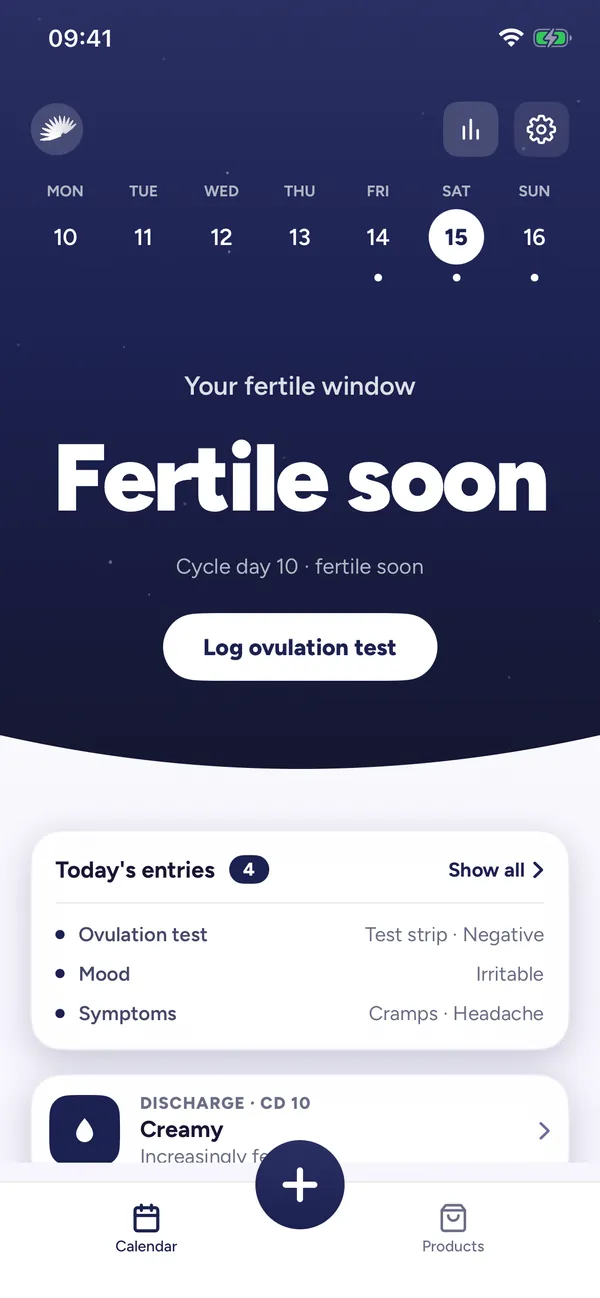
In Cyelle, the days after ovulation appear as DPO+1, DPO+2 …, and the count follows the prediction of ovulation. Your actual ovulation can be a few days earlier or later. If you’ve used ovulation tests, you can treat the day after the positive test as ovulation in your own calculation; that, too, remains a calculation, and Cyelle may count differently. Neither this calculation nor observing your cycle is suitable for contraception.
In the days of implantation, hCG in urine is still very low. A test is therefore usually still negative at this time, even if you’re pregnant. Very sensitive early tests can show a result in some pregnancies from about DPO+10 or DPO+11, standard tests usually only around the day your period is due; a negative before then allows no conclusion. Digital tests detect the same hormone, so the same timing applies.
The bleeding that was observed came later, around the day the period was expected. That explains the mix-up: light bleeding at this point looks like a light or late period, and from the outside you can’t tell the two apart. The expected date is a prediction. The luteal phase, the time between ovulation and your period, is a little different in length for every woman, usually 7–17 days. DPO+14 is therefore not automatically the day of your period, and your own last cycles tell you more than an average.
Implantation happens days before a test can show anything.
Is implantation pain real?
There’s no reliable study on implantation pain either. That you can feel implantation is not proven. Where percentages for it appear online, a source is usually missing. If you feel something in these days, it’s real; it just can’t be said whether implantation is the cause.
Pulling in the lower abdomen, breast tenderness, bloating and tiredness are common in the days after ovulation, whether you’re pregnant or not, because the hormone progesterone rises after ovulation. A feeling alone therefore can’t tell you whether you’re pregnant, and it says nothing about how a pregnancy is going.
This helps while you wait:
- Note symptoms with the date, if that helps you, rather than trying to interpret them.
- A negative before the day your period is due says little; a positive shows hCG.
- Severe or one-sided pain should be checked by a doctor today, and right away if your test is positive. If you feel dizzy or faint, call 911; for shoulder pain, go to the ER right away.
The two-week wait, the two weeks between ovulation and testing, is the hardest time for many. Every twinge becomes a sign, every absence a disappointment. Neither can be interpreted from the outside, and paying attention isn’t a mistake. After many cycles full of hope, it’s all the more understandable.
Cycle and pregnancy in one app.
Cyelle accompanies your cycle, your wish to conceive and your pregnancy. You decide at any time which module fits right now.
Try it free for 3 days. Then a monthly or yearly subscription, both modules included.
Color and length: not proven
There’s No evidence on the color, length or amount of early bleeding, including for “pink means implantation, red means period”. Color, amount and length don’t tell you whether a bleed has anything to do with a pregnancy. Photos online that suggest otherwise show individual cases and can’t be used for comparison.
For how urgent it is, amount and pain do count, though: if bleeding continues, gets heavier or pain comes with it, it’s best to have it checked by a doctor. The signs are in the box at the end.
Implantation or period?
A bleed around the day your period is due can’t be assigned from the outside. Light bleeding can be a light or late period, spotting between periods, or bleeding despite pregnancy. A test taken on the day of your missed period tells you more than the bleeding does; if it’s negative, test again after 2–3 days.
What you noticed is real, even if its cause can’t be determined.
What it can mean
If you bleed early on, you want to know what it is. Only a medical exam gives an honest answer. Without one, all you can do is list possibilities that a doctor can sort out:
- The cervix: During pregnancy it has a better blood supply and is more sensitive. Spotting after sex or after an exam happens; if a pregnancy is confirmed, it’s still best to have it checked.
- A period or spotting between periods without pregnancy: Light bleeding before or after your period, around mid-cycle or on hormonal birth control also happens without a pregnancy.
- Light bleeding on your usual period date despite pregnancy: It happens. Without a medical exam it can’t be sorted out.
- No identifiable cause: Sometimes none is found, even after a careful exam.
There are also rarer but urgent causes that only a medical exam can tell apart. Their signs are in the box “When to get medical help”: heavy bleeding, severe or one-sided pain, shoulder pain, dizziness.
After an embryo transfer
If you’re having fertility treatment, you calculate differently: the timing of implantation depends on the transfer day, not on ovulation. The DPO count then doesn’t fit. Your fertility clinic will tell you which days apply for testing and bleeding, and when a test can show a result. Tell them about any bleeding, even if it’s light, and ask which number to call for emergencies on weekends.
After an early loss
The next paragraph is about a very early loss. If you don’t want to read that right now, skip it.
Some pregnancies end before a test turns positive or shortly after. Often it is due to how the pregnancy itself develops, and you did nothing wrong. Even if a test was never positive, you’re allowed to feel sad. If you’ve already had a loss, every new bleed brings fear again: you may call earlier and don’t have to justify it. In the US, places to turn after a loss include Share Pregnancy & Infant Loss Support and Postpartum Support International (PSI); your care team can also tell you about local support groups.
Cycle and pregnancy in one app.
Cyelle accompanies your cycle, your wish to conceive and your pregnancy. You decide at any time which module fits right now.
Try it free for 3 days. Then a monthly or yearly subscription, both modules included.
Bleeding and a test: what now
What you can do depends on whether the test is positive or your period is late. That also applies if the pregnancy wasn’t planned. A test makes sense from the day your period is missed. If your cycle is irregular or you don’t know the date, test no earlier than 21 days after the last time you had sex that could have led to pregnancy.
- The test is positive and you’re bleeding, even lightly: Call your ob-gyn’s office today and say that you’re pregnant and bleeding; if a midwife is already caring for you, tell her too. Outside office hours, call the same office: there’s usually someone on call. If you can’t get an appointment today, ask your ob-gyn’s office where to go, or go to the ER. This applies in every week of early pregnancy, including weeks 4, 5 or 6, and you don’t have to wait for the first prenatal visit.
- The test is negative, your period is late, you have light spotting and no pain: Watch the bleeding and repeat the test after 2–3 days. If the second test is also negative and your period still doesn’t come, or if the bleeding gets heavier or painful, talk to your ob-gyn’s office.
- You haven’t tested yet and you have spotting: If it’s only spotting, test on the day your period is due. If the bleeding becomes heavy like a period, count the first day as cycle day 1; if a test is positive, the box at the end applies.
- You bleed several times between periods, repeatedly after sex or with pain: It’s best to have this checked by a doctor. Note the times and make an appointment in the next few days.
- The bleeding is heavy, with severe pain or dizziness: Then the box “When to get medical help” at the end applies. Go to the ER right away; if you feel dizzy or faint, call 911.
At the office, you can usually expect an ultrasound and sometimes an hCG blood test. Very early on, an ultrasound sometimes shows nothing yet; the office will then schedule a follow-up.
These details help in the conversation: since when you’ve been bleeding, the color, the amount (for example, how quickly a pad soaks through), whether pain comes with it, whether tissue or clots have passed and what a test has shown.
If you’re reading as a partner: don’t interpret the bleeding for her, ask whether she’d like to call, and go with her. If she faints, feels dizzy or can’t get to a hospital herself, call 911 (or your local emergency number); for the other signs in the box, go to the ER together right away.
Cycle and pregnancy in one app.
Cyelle accompanies your cycle, your wish to conceive and your pregnancy. You decide at any time which module fits right now.
Try it free for 3 days. Then a monthly or yearly subscription, both modules included.
What you log in Cyelle
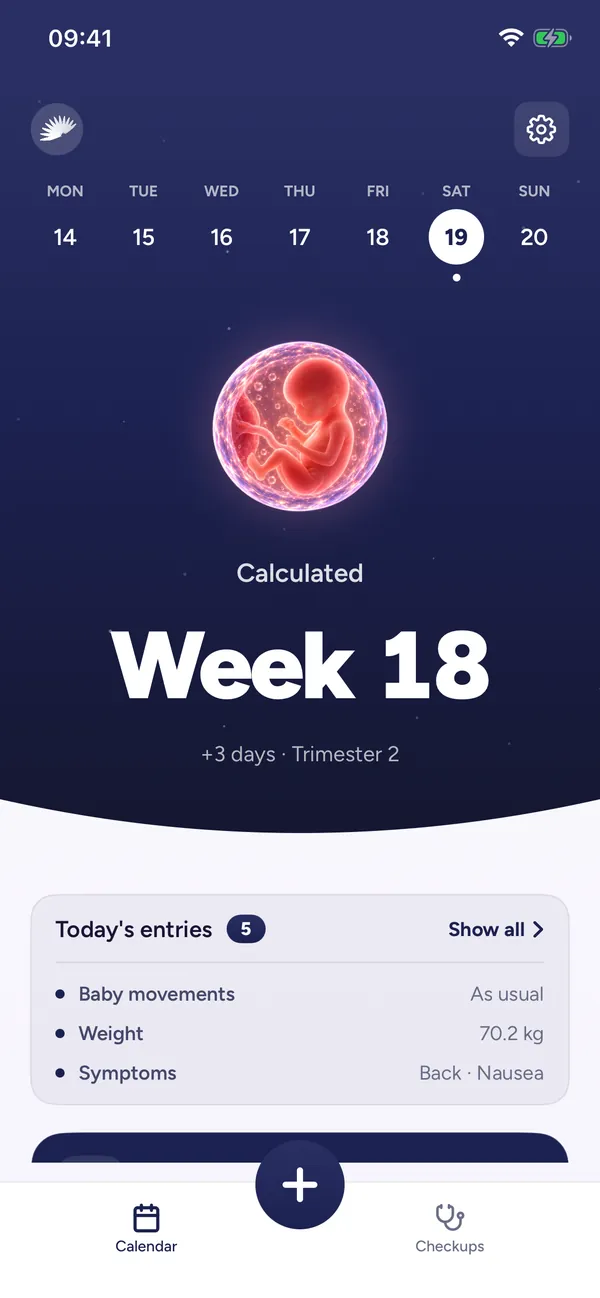
Cyelle stores entries with a date; it doesn’t say what a bleed means. In the Cycle module, you log the pregnancy test with the result you read yourself, without a photo, plus discharge with its type (for example “Brown” or “Pink”), symptoms and notes. In the Pregnancy module, you log bleeding and pain in your entries. You’ll find everything you’ve logged under “My entries.”
Predictions are calculations and can be off by days. With heavy bleeding and pain, you get help first and log afterward.
If you note the date, amount and pain, you can answer more precisely at the office.
The short version
- Implantation bleeding and implantation pain are not proven, and bleeding is not a sign for or against a pregnancy.
- In most pregnancies that last longer than six weeks, there is no bleeding in the first weeks.
- A test shows hCG; a bleed says nothing about it. A test makes sense from the day your period is due; an early negative says little.
- If your test is positive or your period is late, have any bleeding assessed by a doctor today, with severe pain or heavy bleeding right away, and if you faint or feel very dizzy, call 911.
- What a bleed means is clarified by a medical exam; without one, every interpretation remains a guess, and an observation such as color or length doesn’t replace it.
Cyelle calculates ovulation, the fertile window and your period as a prediction that can shift by days. Neither the calculation nor observing your cycle is suitable for contraception.
Frequently asked questions
Can I be pregnant without bleeding?
Yes. In most pregnancies that lasted longer than six weeks, there was no bleeding in the first weeks. In one careful study, only about 9 in 100 pregnant women bled at all in the first eight weeks, and the bleeding rarely came at the time of implantation. Pregnancies that ended earlier aren’t included.
Is implantation bleeding common?
There’s no reliable frequency, because the link between implantation and bleeding is not proven. In one careful study, about 9 in 100 pregnant women whose pregnancy lasted at least six weeks bled in the first eight weeks, mostly around the day their period was expected.
When does implantation happen?
Implantation starts 6–12 days after ovulation, and in about 84 in 100 pregnancies that lasted at least six weeks, on day 8–10 (DPO+8–10). Whether bleeding occurs then is not proven. At this time, a pregnancy test is usually still negative.
How long does implantation bleeding last?
There’s no proven length, because the link with implantation is not proven. If bleeding continues, gets heavier or pain comes with it, it’s best to have it checked by a doctor, the same day if your test is positive or your period is late.
What does implantation bleeding look like?
For no color, amount or length is there evidence that it points to implantation. Whether pink, brown or bright red: how it looks doesn’t reveal the cause. What matters is how heavy the bleeding is and whether pain comes with it.
Implantation bleeding or period: how can you tell?
The two can’t be told apart from the outside. Light bleeding around the expected date can be a light or late period. Take a test on the day your period is missed and repeat it after 2–3 days if it’s negative. That tells you more than the bleeding does.
Is implantation pain real?
There’s no reliable study on it. Pulling in the lower abdomen happens before a period and in early pregnancy and allows no conclusion. Severe or one-sided pain should be checked by a doctor, even without bleeding.
Bleeding after a positive pregnancy test: when should I call my doctor?
If your test is positive or your period is late, the same day, even for spotting without pain: call your ob-gyn’s office; after hours, call the same number, as there’s usually someone on call. With severe pain, shoulder pain or bleeding like a heavy period, go to the ER right away; if you feel dizzy or faint, call 911 (or your local emergency number) right away (US information).
When to get medical help
Get help right away (US information):
- You faint, collapse, feel very dizzy, or cold and weak, or you can’t get to a hospital yourself: Call 911 (or your local emergency number) right away. Don’t drive yourself and don’t stay alone.
- With a positive test or a late period, severe lower abdominal pain or shoulder pain comes with the bleeding: Go to the ER right away.
- With a positive test or a late period, the bleeding is as heavy as a period or heavier, a pad soaks through quickly, or tissue or clots pass: Go to the ER right away.
- Fever with chills comes with the bleeding: Go to the ER right away.
- The test is positive and one-sided lower abdominal pain or brownish, watery spotting comes with it, even without heavy bleeding: Call your ob-gyn’s office right away. If you can’t reach anyone or the pain gets worse, go to the ER. With sudden, very severe pain, go to the ER right away. Severe one-sided pain in early pregnancy must be examined by a doctor right away; only a doctor can sort out the cause.
Have it checked by a doctor today:
- The test is positive or your period is late, and you’re bleeding, even lightly: Call your ob-gyn’s office today; after hours, call the same number, as there’s usually someone on call.
- Severe, one-sided or increasing lower abdominal pain without bleeding, even before a test: Have it checked by a doctor today. If shoulder pain comes with it, go to the ER right away; if you feel dizzy or faint, call 911.
It’s best to have this checked by a doctor:
- You bleed repeatedly between periods, after sex or with pain: Make an appointment in the next few days and bring the times with you.
For orientation only — no substitute for medical advice or diagnosis.
All values are calculations. Cyelle is not a contraceptive and does not provide diagnoses.