
When should you see an ob-gyn after a positive pregnancy test? Call your ob-gyn’s office in the next few days and ask for an appointment for the first prenatal visit. How soon one is free depends on the office. With bleeding, one-sided pain, or if you feel faint or dizzy, you don’t wait for this appointment: Then call your ob-gyn’s office right away; after hours, call the same number, as there’s usually someone on call. With heavy bleeding, sudden severe lower abdominal pain, shoulder pain, dizziness or fainting, call 911 (or your local emergency number). You’ll find more in the box “When not to wait?” at the end.
At a glance
- Call your ob-gyn
- soon
- Gestational sac
- 5th–6th week
- Heartbeat usually
- 6th–7th week
- Early ultrasound
- Common, optional
When to see an ob-gyn
In the US, no nationwide prenatal care plan sets when you see an ob-gyn after a positive test; your provider’s office and your plan decide the details. Call soon after the test, and the office will tell you when they want to see you. You don’t have to be at the office today, but you shouldn’t put off the call. This is enough for today:
- Call your ob-gyn’s office and say: “I tested positive and need an appointment for the first prenatal visit.” Depending on your plan, you may or may not need a referral; ask when you book.
- Give the first day of your last period. If you don’t know it, your cycle is irregular or you recently stopped the pill or other hormones, say so. Your doctor will then date the pregnancy with an ultrasound.
- Also say on the phone if you’ve ever had an ectopic pregnancy (a pregnancy outside the uterus), had surgery on your fallopian tubes, are having fertility treatment or have an IUD. Details like these help the office decide how soon to see you. If you’ve already had a miscarriage, you’re allowed to ask whether an earlier appointment is possible.
- Write down your questions, on a piece of paper or in your phone.
How quickly you get an appointment depends on the office, and in the first weeks an ultrasound often still shows little. The wait can feel long. You’re allowed to ask about an earlier appointment, a waitlist or cancellations. If you’re having fertility treatment, your clinic’s appointments apply. If you’re further along in the pregnancy and still have no appointment, call now anyway.
Counting weeks of pregnancy
Weeks of pregnancy (also called gestational age) are counted from the first day of your last period, not from conception. The number before the plus is full weeks, the number after it is days: “6+2” (6 weeks, 2 days) means six full weeks and two days, so the seventh week is under way.
An example: if your last period began on September 1, then on September 29 you are, by calculation, at 4+0 (4 weeks, 0 days). With a 28-day cycle, that is the day your period is due. Two weeks later, on October 13, it would be 6+0 (6 weeks, 0 days) by calculation.
Your office calculates the due date with Naegele’s rule: first day of the last period plus 280 days. If you have a regular cycle that is longer or shorter than 28 days, the due date shifts by the difference from 28 days. If the day of ovulation is known, ovulation plus 266 days applies. The due date is a window, not a point: most babies come in the two weeks before or after it, and only about 4 in 100 exactly on the due date. If the ultrasound differs from the calculation, your doctor may set a new due date. What counts is the due date in your prenatal records.
This calculation dates an existing pregnancy. It says nothing about which days a pregnancy is possible and is not suitable for contraception.
Cycle and pregnancy in one app.
Cyelle accompanies your cycle, your wish to conceive and your pregnancy. You decide at any time which module fits right now.


Try it free for 3 days. Then a monthly or yearly subscription, both modules included.
What the ultrasound shows
On an ultrasound, the gestational sac can often be seen in the 5th to 6th week, and cardiac activity (the heartbeat) in the 6th to 7th week (the week in progress, not the “weeks+days” notation). These are ranges, not deadlines. How early something can be seen also depends on when ovulation was. At the beginning that is often only known roughly. If ovulation was later than calculated, the pregnancy is less far along than the number says.
In the US, the timing of ultrasounds isn’t set nationwide. Most people have at least one detailed ultrasound at around 18 to 22 weeks; an earlier scan is common but not required. Dating is most accurate with an ultrasound in the first trimester. When you book, ask: “Is an ultrasound part of this visit, and what does it cost if it isn’t?” With bleeding or pain, you don’t wait for routine care but call.
If not everything can be seen at an early appointment, it is often because it is still too early by calculation. That can often only be said at a second check. At the end of the appointment, ask whether and when a follow-up makes sense, and have it explained what can be seen and what can’t. Feel free to bring someone along.
An early appointment sometimes doesn’t show everything yet.
What the first visit involves
There is a lot to discuss at the first prenatal visit. It usually includes:
- a conversation about your health, earlier pregnancies and existing conditions,
- a physical exam with blood pressure and weight,
- a blood draw, including blood type, Rh factor and antibodies; this includes tests for rubella, syphilis, hepatitis B and HIV; you’ll be told about the HIV test and can decline it,
- a urine test for an infection that often causes no symptoms,
- often an ultrasound,
- the start of your prenatal records.
There is no single pregnancy booklet in the US. Your office keeps your chart, and many offices have a patient portal. Ask your ob-gyn or midwife for a copy of your prenatal records and keep it with you, especially late in pregnancy or when you travel. You can ask at any time why something is being done and whether it is part of routine care that your plan covers or an extra you pay for yourself. How much of prenatal care your plan covers depends on your plan; ask the office about your deductible and copay.
After that, how often you’re seen depends on your provider’s office, your plan and your health; there is no nationwide schedule.
Cycle and pregnancy in one app.
Cyelle accompanies your cycle, your wish to conceive and your pregnancy. You decide at any time which module fits right now.
Try it free for 3 days. Then a monthly or yearly subscription, both modules included.
What to bring
You don’t have to prepare anything special. Ask when you book whether you should come fasting. It helps to bring:
- your insurance card and, if you have them, earlier prenatal records or vaccination records,
- the first day of your last period and the length of your cycle,
- a list of the medicines you take regularly, with doses,
- existing conditions and surgeries you can think of,
- your questions, for example: When is the next appointment? Whom do I call if something happens?
Don’t stop taking medicines on your own; talk to your provider first. MotherToBaby (1-866-626-6847), a nonprofit information service, is an additional place to turn to for free, expert information on medicines in pregnancy and breastfeeding. Ask the office beforehand whether someone may come with you. A companion can listen and take notes.
Midwife or ob-gyn?
Prenatal checkups can be done by an ob-gyn or by a certified nurse-midwife (CNM). Ask early about midwife care, because openings can be limited. Your health plan can help you search.
Telling your employer
In the US, there’s no national maternity protection law. What you’re entitled to depends on your employer, how long you’ve worked there and your state. Ask HR about FMLA, paid leave and pregnancy accommodations, and about when and how to tell them. Many employers must make reasonable adjustments for pregnancy-related needs.
No appointment in sight?
If all the offices near you are booked or yours is closed for vacation, this order helps:
- Call again and say explicitly that you tested positive and need a first prenatal visit. Ask about a waitlist, about cancellations and about a covering practice.
- Call your health plan’s member line or check its provider directory for ob-gyn practices with openings.
- Ask your health plan whether certified nurse-midwife (CNM) practices near you have openings.
- If you have symptoms that worry you but aren’t an emergency, call your ob-gyn’s office; there’s usually someone on call in the evening, at night and on weekends when the offices are closed. If you don’t have an ob-gyn yet, many health plans have a 24/7 nurse line.
Your doctor confirms the pregnancy through an exam and ultrasound. A blood test shows the pregnancy hormone hCG slightly earlier than a urine test. The office decides whether it is needed, and whether your plan covers it is something to ask beforehand.
You’re allowed to call and ask.
Until your appointment
The time between the test and the appointment often feels long. If a later test turns negative or bleeding comes along, call your ob-gyn’s office. If something worries you, call too. You don’t need an emergency to do so.
Note the first day of your last period and collect your questions. For folic acid there is a general recommendation: if you started at least four weeks before the pregnancy, you keep taking 400 micrograms (mcg) daily until the end of the 12th week of pregnancy. If you only started now, some professional societies, for example in Germany, recommend 800 mcg daily until the end of the 12th week; in the US, the CDC recommends 400 mcg daily for anyone who could become pregnant. With existing conditions or medicines, a different dose may be needed; you clarify that with your provider’s office. Don’t wait for the appointment to start. For alcohol and smoking there is no amount considered safe. You can get help quitting at your provider’s office. You don’t have to blame yourself for anything you did before the test. You don’t have to tell anyone about the pregnancy right away.
Maybe you don’t feel joy but fear. That happens to women who wanted this pregnancy, too, and to women who have lost a pregnancy before. Talk about the fear at your ob-gyn’s office. For people who have experienced a loss, Share Pregnancy & Infant Loss Support is a place to turn to in the US.
If the pregnancy wasn’t planned or you’re unsure, talk it over with your provider’s office or a counselor.
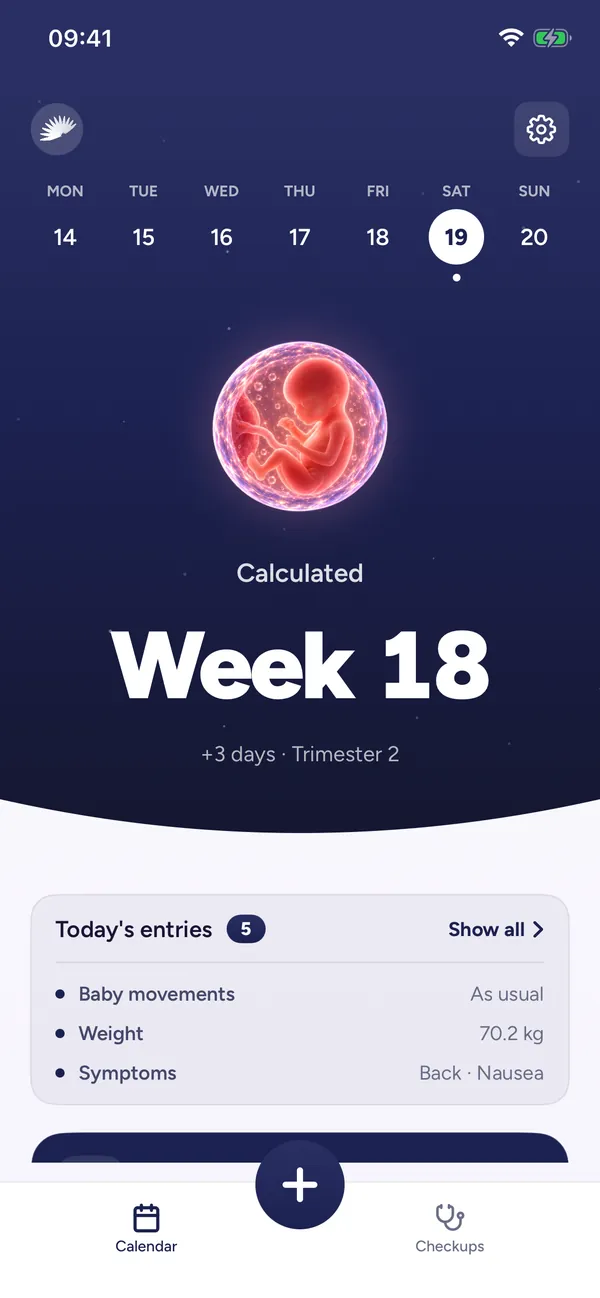
In Cyelle’s pregnancy module you create your appointment as its own entry and can have yourself reminded if you switch the reminder on. If an appointment is closer than the lead time you chose, there is no reminder. If you have entered cycle data, after a positive pregnancy test Cyelle calculates the weeks of pregnancy and the due date from it, with the formula named and always with a time window. That is a calculation from your entries and can differ from the ultrasound. You can enter the due date from your prenatal records yourself. You keep questions and symptoms as a note in My entries. Cyelle doesn’t evaluate them and doesn’t replace a call when there are warning signs.
Frequently asked questions
When should I see an ob-gyn after a positive pregnancy test?
Call your ob-gyn’s office in the next few days and ask for an appointment for the first prenatal visit. In the US, no nationwide prenatal care plan names a fixed week; the office tells you when they want to see you. How soon an appointment is free depends on the office. With bleeding, one-sided pain, or if you feel faint or dizzy, you don’t wait: call your ob-gyn’s office right away; after hours, call the same number, as there’s usually someone on call. With heavy bleeding, sudden severe lower abdominal pain, shoulder pain, dizziness or fainting, call 911 (or your local emergency number). For orientation only — no substitute for medical advice or diagnosis.
How long do I have to wait for the first appointment?
That depends on the office and can’t be said across the board. Ask about a waitlist and about cancellations. Your health plan’s member line or provider directory can help you find a practice with openings. Depending on your plan, you may need a referral; ask when you book.
When can you see the heartbeat on an ultrasound?
The gestational sac can often be seen in the 5th to 6th week, cardiac activity (the heartbeat) in the 6th to 7th week (week in progress). These are ranges, not deadlines, because it depends on your cycle and the timing of your ovulation. What can be seen and whether a second check makes sense is decided by your doctor case by case.
Why is there nothing to see on an early ultrasound?
In the first weeks there is often nothing or only little to see yet, because at the beginning the exact day is often only known roughly. If ovulation was later than calculated, the pregnancy is less far along than the number says. Your doctor judges that case by case and offers you a second check if needed. With bleeding, one-sided pain, or if you feel faint or dizzy, you don’t wait for the appointment: call your ob-gyn’s office right away; after hours, call the same number, as there’s usually someone on call. With heavy bleeding, sudden severe lower abdominal pain, shoulder pain, dizziness or fainting, call 911 (or your local emergency number). For orientation only — no substitute for medical advice or diagnosis.
What happens at the first ob-gyn appointment?
You have a conversation about your health, there is a physical exam, a blood draw, a urine test, often an ultrasound, and your prenatal records are started.
What should I bring to the first appointment?
Your insurance card, the first day of your last period, the length of your cycle, a list of your medicines and your questions. Ask when you book whether you should come fasting.
Can my partner come to the first appointment?
Ask the office beforehand whether someone may come with you. A companion can listen and take notes, and many questions come more easily with two.
Can a midwife handle my prenatal care?
Yes, prenatal checkups can be done by a certified nurse-midwife (CNM) or an ob-gyn. Your office keeps your prenatal records; ask for a copy.
When not to wait?
US information. Get help right away:
- You suddenly have severe lower abdominal pain, you feel dizzy, your vision goes dark or you feel sick, you are noticeably pale or you have pain in your shoulder: Call 911 (or your local emergency number) right away. Don’t drive yourself.
- You have pain so strong that you can’t concentrate on anything else: Call 911 (or your local emergency number) right away. Don’t drive yourself.
- You are bleeding heavily, a pad is soaked again soon after changing it: Call 911 (or your local emergency number). Don’t drive yourself.
- You have pain on only one side of the lower abdomen, with or without bleeding: Call your ob-gyn’s office right away; after hours, call the same number, as there’s usually someone on call. If you can’t reach anyone, go to the ER.
- You have a fever together with pain or bleeding: Call your ob-gyn’s office right away; after hours, call the same number, as there’s usually someone on call. If you can’t reach anyone, go to the ER.
As long as an ultrasound hasn’t confirmed where the pregnancy is developing, these signs matter especially. It’s best to have this checked by a doctor today:
- You notice that tissue is passing: Call your ob-gyn’s office today; if it’s closed, call the same number, as there’s usually someone on call. If you can’t reach anyone, go to the ER.
- You have cramps that come and go and that you can manage: Call your ob-gyn’s office today; if it’s closed, call the same number, as there’s usually someone on call.
- You have pain when urinating or having a bowel movement together with lower abdominal pain: Call your ob-gyn’s office today; if it’s closed, call the same number, as there’s usually someone on call.
- You have light spotting or twinges in your lower abdomen: Call your ob-gyn’s office the same day; if it’s closed, call the same number, as there’s usually someone on call.
- You vomit so often that you haven’t kept anything down for 24 hours, your urine is very dark or you haven’t urinated in more than 8 hours, or you feel weak and dizzy when you stand up: Call your ob-gyn’s office the same day.
For orientation only — no substitute for medical advice or diagnosis.
All values are calculations. Cyelle is not a contraceptive and does not provide diagnoses.