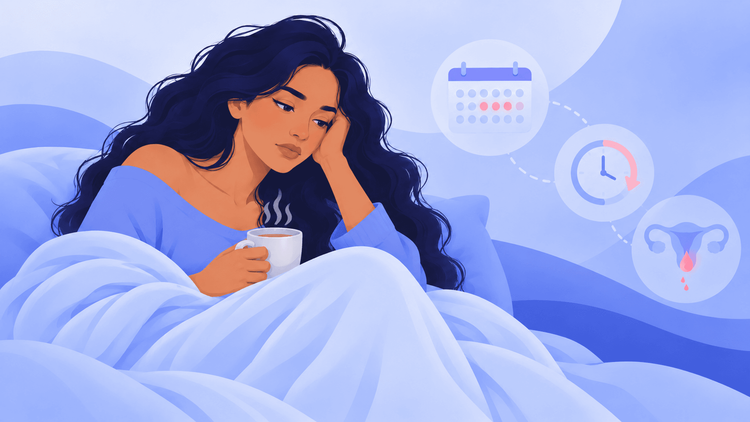
Your first period after a miscarriage often comes about five to six weeks later, sometimes earlier, sometimes later. Ovulation can come back before that, and a pregnancy test can stay positive for a few weeks because of leftover hCG.
If you’re bleeding very heavily right now, feel dizzy or faint, call 911 (or your local emergency number) right away. More warning signs are in the box at the end (US information).
At a glance
- First period after
- often 5–6 weeks
- Bleeding can last
- up to 3 weeks
- Test still positive
- a few weeks
- Checkup usually after
- 7–14 days
When will my period return?
A miscarriage is a loss, and it’s understandable that you want to know what happens physically next and when your period will come back. An early miscarriage is, as a rule, nothing anyone could have prevented. This text applies mainly to early miscarriages up to 12 weeks. For later losses, the section on time off at the end also applies; everything else you talk through with your ob-gyn’s office.
Your first period usually starts about five to six weeks after the miscarriage. That also depends on how far along the pregnancy was, and up to eight weeks is still considered possible. There’s no set day to count from, so plan with a range instead of a date. For a natural miscarriage, medication or a D&C, there are no separate, reliable numbers.
The bleeding of the miscarriage itself isn’t a period. It can last up to three weeks, in some cases longer. It usually gets lighter after the loss. If it comes back heavier after a pause, that is something to have checked by a doctor. Only the bleeding after that, after a new cycle with ovulation, is your first period.
Three markers can help while you wait:
- The bleeding from the loss is slowly getting lighter: You’re waiting for your first period. That doesn’t change the checkup at your ob-gyn’s office.
- About eight weeks have passed and there’s still no period: Take a pregnancy test and call your ob-gyn’s office to have it checked. That’s not a rigid deadline, but a good time.
- The bleeding gets heavier again after a pause or lasts longer than about three weeks: It’s best to have this checked by a doctor.
Cycle and pregnancy in one app.
Cyelle accompanies your cycle, your wish to conceive and your pregnancy. You decide at any time which module fits right now.


Try it free for 3 days. Then a monthly or yearly subscription, both modules included.
Heavier or longer period?
Your first period after a miscarriage can be different from before, for example heavier, lighter, shorter or longer. It can take a few months for your cycle to settle again.
For the bleeding right after the loss, pads are the simplest choice: some sources advise pads instead of tampons in the first days, while others also list tampons and menstrual cups as possible. For your first period you can use whatever suits you. You don’t have to give up exercise. Recommendations on sex differ: some sources see no reason to hold off, others advise waiting until the bleeding has ended. You decide by how you feel, and if you have pain or are unsure, ask at your ob-gyn’s office.
If a pad is soaked again soon after you change it, or you feel dizzy, call 911 (or your local emergency number) right away. If the bleeding stays heavy for weeks, talk to your ob-gyn’s office.
Ovulation after miscarriage
Ovulation can come back after a miscarriage before your first period arrives. In most women it returns within a few weeks, in individual cases after as little as eight to ten days. As a rule, this first ovulation comes before the first period.
You may not notice it at all. It says nothing about how you feel or whether you want to get pregnant. It only means that a new pregnancy is possible before the first period: even when your period hasn’t come, a pregnancy isn’t ruled out.
Calculations, observation and ovulation tests are not suitable for birth control in any cycle, and after a miscarriage the cycle is especially hard to predict. If you don’t want to get pregnant in the coming weeks, it’s best to talk about birth control at your checkup, not to wait until after your first period.
Cycle day 1 after miscarriage
For counting after a miscarriage: cycle day 1 is usually the first day of a period. Because the bleeding of a miscarriage isn’t a period, your first new cycle begins with your first period. Pick one way of counting and stay with it.
Predictions are especially uncertain after a loss, so plan with a time window instead of a date. Even in a typical cycle, “ovulation = cycle length minus 14” is only an approximation: in a 28-day cycle, ovulation falls exactly 14 days before the next period in only about one in ten cycles.
Cycle and pregnancy in one app.
Cyelle accompanies your cycle, your wish to conceive and your pregnancy. You decide at any time which module fits right now.
Try it free for 3 days. Then a monthly or yearly subscription, both modules included.
Test still positive: how long?
A pregnancy test can still be positive after a miscarriage because there’s leftover hCG in your body. This hormone is made during pregnancy. After the loss it drops, but for a while it stays above the very small amount a home test responds to.
How long that takes depends on how high the hCG was before. The further along the pregnancy was, the longer it usually takes. Often it’s a few weeks, in individual cases longer. A positive test after about three weeks can still happen. It’s a good reason to ask at your ob-gyn’s office, where a blood test and an ultrasound can clarify how things are going.
A single line says nothing yet about a new pregnancy during this time. It only shows that there’s hCG in your urine. What matters is the trend: if the line gets fainter, that’s the expected course. If it turns positive again after a negative test, or gets darker again, talk to your ob-gyn’s office promptly.
A digital test (for example from Clearblue) can also still show “Pregnant” after a miscarriage, as long as there’s hCG in your urine.
Testing during this time can be emotionally hard. If you test every day, each line can feel like hope or a setback. You’re also allowed not to test at all.
A single line says little right now.
Ovulation tests after loss
An ovulation test can be hard to read in the first weeks after a miscarriage. It responds to LH, a hormone that rises before ovulation. Leftover hCG can make the result misleading: the line may then have nothing to do with ovulation. Even without hCG, your cycle can be irregular in the first months; several surges are possible, as they are at other times too, and a clear surge may not happen. That doesn’t mean the test is faulty.
In its package insert, Clearblue names a recently ended pregnancy as a possible reason for misleading results and, for the Advanced test, recommends waiting two cycles before you test.
Here’s how to go about it if you want to test:
- First, a negative pregnancy test. As long as it’s positive, an ovulation test says little.
- Read the line only within the time given in the package insert, and write down the date, the time and what you see.
- With a strip test, it counts as positive when the test line is at least as dark as the control line. That’s a manufacturer convention, not a medical limit. A lighter line stays negative.
- A positive test shows an LH surge, not ovulation. After an LH surge, ovulation often follows within about one to two days, but not always. A surge can also happen without ovulation, and a negative test doesn’t rule out ovulation.
With Clearblue purple (Advanced), the flashing smiley shows a rise in estrogen, the static smiley an LH surge. Clearblue pink (Digital) has only the empty circle and the static smiley. A cycle without a static smiley is possible and doesn’t mean anything is wrong with the test. Ovulation tests are not suitable for birth control. Whether you want to test is up to you; it’s never a must.
Cycle and pregnancy in one app.
Cyelle accompanies your cycle, your wish to conceive and your pregnancy. You decide at any time which module fits right now.
Try it free for 3 days. Then a monthly or yearly subscription, both modules included.
Checkup and when to call
A checkup after a miscarriage is part of the process, even if the bleeding has already eased. After a natural or medication-managed miscarriage, an ultrasound check after about seven to fourteen days is usual. If you haven’t had one yet, call your provider’s office and make an appointment, even without symptoms. After a D&C, you talk through aftercare with the office or the hospital.
More reasons to call the office:
- The bleeding lasts longer than about three weeks or gets heavier again after a pause.
- Your pregnancy test is still positive after about three weeks or turns positive again after a negative result.
- Your first period hasn’t come after about eight weeks.
- You’re Rh-negative (your blood type is in your prenatal records, if you have them; otherwise ask the office): Talk with the office about whether you need an Rh immune globulin shot (also called anti-D), and bring it up as soon as possible if no one has mentioned it.
- You’ve had more than one miscarriage. Further testing is usually arranged after three miscarriages, and genetic testing of the tissue makes sense after two. You can also ask about an evaluation sooner.
Outside office hours, call your ob-gyn’s office. There’s usually someone on call after hours. This is for symptoms that can’t wait until the next day but aren’t life-threatening. If you can’t reach anyone, go to the ER. In an emergency, call 911 (or your local emergency number) right away. If you’re in fertility treatment, call your clinic first. All of this is US information.
A checkup is part of it, even without symptoms.
No timeline needed
There’s no medical deadline. Once you feel ready and a cycle with ovulation takes place, a new pregnancy is possible. After a natural miscarriage, you don’t need to wait for a cycle first. After a D&C, it can make sense to wait for one period so the uterine lining can recover. You talk that through with your ob-gyn’s office.
If a new pregnancy begins before your first period, there’s no period start date to base the calculation on. Your ob-gyn’s office then dates the pregnancy by ultrasound.
Whether and when you want to try again is up to you, with no deadline. If you don’t want to get pregnant right now, this is just as much for you. In fertility treatment, your clinic’s plan comes first. Ask there, too, when a test is meaningful after hormone injections.
No one did anything wrong in an early miscarriage. In the first weeks, it’s often due to random changes in the genetic material.
You don’t have to decide anything today.
Time off after miscarriage
In the US, there’s no national maternity protection law. What you’re entitled to depends on your employer, how long you’ve worked there and your state. Other countries have different rules. Ask HR about FMLA, paid leave and pregnancy accommodations.
If the miscarriage affects you physically or emotionally so that you can’t work, your provider can write a note for your employer.
Depending on your employer, FMLA (the Family and Medical Leave Act) can give you up to 12 weeks of unpaid leave with job protection if you’ve worked there for at least 12 months and 1,250 hours in the past year, and your employer has at least 50 employees within 75 miles of your workplace. Recovery after a miscarriage may qualify as a health condition under FMLA, so ask HR.
Many employers must also make reasonable adjustments for pregnancy-related needs, including after a miscarriage. Some states have paid family leave. What applies to you depends on your state and your employer.
Cycle and pregnancy in one app.
Cyelle accompanies your cycle, your wish to conceive and your pregnancy. You decide at any time which module fits right now.
Try it free for 3 days. Then a monthly or yearly subscription, both modules included.
Grief, partners, support
The emotional pain after a miscarriage is often unexpectedly big. Grief follows no pattern; it lasts a different length of time for everyone and has highs and lows. Partners grieve too, often differently than you. Grief and anxiety are common after a loss, as are low mood and mood swings.
If you notice that you can’t cope on your own, reach out for help: to your primary care provider or ob-gyn’s office, to a midwife, or to a support organization such as Share Pregnancy & Infant Loss Support. You can also ask your care team about local support groups.
After a pregnancy loss, you can turn to your ob-gyn’s office or a certified nurse-midwife for follow-up care, even if you have no symptoms. What your health plan covers depends on the plan, so ask the office or your insurer.
If you’re feeling very low
The 988 Suicide & Crisis Lifeline is free, confidential and open around the clock: call or text 988 (US information). If you’re thinking about hurting yourself, call or text 988 or call 911 right away. For support during or after pregnancy, you can also call or text the National Maternal Mental Health Hotline at 1-833-852-6262. It isn’t a crisis line, so in a crisis use 988.
For orientation only — no substitute for medical advice or diagnosis.
Track it or take a break
You don’t have to log anything. Neither a calendar nor a slip of paper requires you to record days, tests or symptoms in the first weeks. If writing things down helps, write down what and when you like. If not, leave it. If you want to keep symptoms or questions for your appointment, a short note with the date is enough.
One rule helps when logging: the bleeding of a miscarriage doesn’t belong in a cycle calendar as a period, because predictions would otherwise start from the wrong day. A note or a symptom is enough; you log your first period when it arrives. You can ignore predictions during this time.
Frequently asked questions
When does your period come after a miscarriage?
Your first period often comes after about five to six weeks. That also depends on how far along the pregnancy was; up to about eight weeks is considered possible. The timing can’t be predicted exactly. The bleeding of the miscarriage itself isn’t a period and can last up to three weeks, in some cases longer. If your period hasn’t come after about eight weeks, take a pregnancy test and call your ob-gyn’s office.
When does your period come after a D&C?
There are no separate, reliable numbers for the time until the first period by type of miscarriage. The general figure of about five to six weeks applies here too, with the possibility of a delay. After a D&C, it can make sense to wait for one period before planning a new pregnancy so the uterine lining can recover. You talk through aftercare with your ob-gyn’s office or the hospital.
How long is a pregnancy test positive after a miscarriage?
Because of leftover hCG, a pregnancy test can stay positive for a few weeks, in individual cases longer. The further along the pregnancy was, the longer it usually takes. A line that gets fainter is the expected course. A positive test after about three weeks is a reason to ask at your ob-gyn’s office. If the test turns positive again after a negative result, or the line gets darker again, talk to your ob-gyn’s office promptly.
Can ovulation come before the first period after a miscarriage?
Yes. In most women, ovulation returns within a few weeks, in individual cases after as little as eight to ten days. As a rule, it comes before the first period. A new pregnancy is therefore possible even earlier. Calculations, observation and ovulation tests are not suitable for birth control in any cycle. If you don’t want to get pregnant, it’s best to talk about birth control at your checkup at your ob-gyn’s office.
Why is my first period after a miscarriage heavier or longer?
It can be different from before. It can take a few months for your cycle to settle again. If a pad is soaked again soon after you change it, or you feel dizzy, call 911 (or your local emergency number) right away. If the bleeding stays heavy for weeks, talk to your ob-gyn’s office.
Can an ovulation test be positive after a miscarriage?
In the first weeks, leftover hCG can make the result of an ovulation test misleading, so that the line has nothing to do with ovulation. Later, too, your cycle can be irregular, with several surges or no clear one. A positive test shows an LH surge, not ovulation. Ovulation tests are not suitable for birth control.
What if your period doesn’t come after a miscarriage?
If your period hasn’t come after about eight weeks, take a pregnancy test and call your ob-gyn’s office to have it checked. That’s not a rigid deadline, but a good time. Even when your period hasn’t come, a pregnancy isn’t ruled out. A test can, however, still be positive for a few weeks because of leftover hCG and then says little on its own. It can take a few months for your cycle to settle again.
Is there time off or a doctor’s note after a miscarriage?
In the US, there’s no national maternity protection law, so it depends on your employer, how long you’ve worked there and your state. If you can’t work, your provider can write a note. FMLA may give you up to 12 weeks of unpaid leave with job protection if you meet its requirements, and many employers must make reasonable adjustments for pregnancy-related needs, including after a miscarriage. Some states have paid family leave. Ask HR. Other countries have other rules.
Get help right away
Don’t wait if you notice these signs. Call 911 (or your local emergency number) right away for:
- fainting, dizziness or feeling like you might pass out
- very heavy bleeding, where a pad is soaked again soon after you change it
- pain so severe that you can’t do anything else
Go to the ER right away (call 911 if you can’t get there safely) for:
- severe or worsening lower abdominal pain, or pain on one side only
- shoulder pain together with lower abdominal pain
- fever above 100.4 °F (38 °C) or chills, especially together with lower abdominal pain or feeling very sick
- a test that turns positive again after a negative result, together with one-sided or severe lower abdominal pain
Have it checked soon, ideally the same day at your ob-gyn’s office:
- foul-smelling discharge
- lower abdominal pain that doesn’t ease
- bleeding that gets heavier again after a pause
- a test that turns positive again after a negative result
Outside office hours, call your ob-gyn’s office for symptoms that aren’t life-threatening but can’t wait. There’s usually someone on call after hours. If you can’t reach anyone, go to the ER. All advice here is for the US.
For orientation only — no substitute for medical advice or diagnosis.
All values are calculations. Cyelle is not a contraceptive and does not provide diagnoses.