
Calculating ovulation means counting backward: it is calculated to fall about 14 days before your next period, so it depends on your cycle length. With a 28-day cycle that is around cycle day 14 or 15, with a 35-day cycle around day 19 to 21 (rule of thumb and average). Because it varies from cycle to cycle, it can only be calculated as a window of days, not as a single day.
Below, you’ll find the calculation in five steps, examples and an overview by cycle length. The calculation is not suitable for contraception.
Calculated window
- Cycles of 26–30 days
- Cycle days 7–16
- Cycles of 28–32 days
- Cycle days 9–18
- Cycles of 30–35 days
- Cycle days 11–21
- Window per ovulation
- 6 days
14 days before your period
Setting ovulation 14 days before your period is the most common calculation: you take the length of your cycle and subtract 14 days. With a 32-day cycle that gives cycle day 18, with a 35-day cycle cycle day 21. The first day of your period is always cycle day 1, and cycle length runs from the first day of one period to the day before the next period starts. The numbers in the overview above are the window that results for the shortest and the longest cycle; the steps further down show how it comes about.
With 28 days, the calculation gives day 14. In 28-day cycles, ovulation was most often on day 15; depending on how you count (ovulation day included or not), you get day 14 or day 15. Both are approximations, because the spread of ovulation is much larger than that one day.
There is a reason to count backward. A cycle consists of the time up to ovulation (follicular phase) and the time after it until the next period (luteal phase). The time before ovulation is the more variable part; the time after it varies less. A long cycle is therefore usually a cycle with a longer time until ovulation.
If you count forward and add 14 days from the first day of your period, you only hit the mark at about 28 days. At 35 days that lands on cycle day 14, counted backward on day 21, a difference of a week. The rule “ovulation on cycle day 14” therefore only holds for cycles of around 28 days, and even there only roughly.
Ovulation by cycle length
Ovulation falls on a different cycle day depending on your cycle length. The overview shows the rule of thumb and the average from large datasets for each group of cycle lengths. All figures are cycle days, approximate and to be read as a range.
- 21–24 days: rule of thumb day 7–10, average about day 12.
- 25–30 days: rule of thumb day 11–16, average about day 15. At 26 days that is day 12 by the rule of thumb and day 15 on average, at 28 days day 14 and day 15, at 30 days day 16 and day 15.
- 31–35 days: rule of thumb day 17–21, average about day 19–20.
- 36–50 days: rule of thumb day 22–36, average about day 27. At 40 days the rule of thumb gives day 26.
The average is the mean across many cycles; it applies to the whole group and therefore changes in steps. For short cycles it falls later than “length minus 14,” because the time after ovulation is also somewhat shorter there, not just the time before. Up to about 26 days the rule of thumb therefore falls too early, most clearly at 21 to 24 days. Between 31 and 35 days the two values differ by at most about three days. On top of each value comes a spread of about four to five days in either direction. These are averages across many women, not a value for you personally.
Cycle and pregnancy in one app.
Cyelle accompanies your cycle, your wish to conceive and your pregnancy. You decide at any time which module fits right now.


Try it free for 3 days. Then a monthly or yearly subscription, both modules included.
Calculate ovulation: 5 steps
Calculating ovulation by cycle length means first working out your own number. You can do that without an app, with a calendar. The steps are a simple rule of thumb, not a method from a medical society.
- Note the first day of each period: the first day of true bleeding, not light spotting before it.
- Count the days from the first day of one period to the day before the first day of the next. If a period starts on May 3 and the next one on June 1, that is 29 days. Repeat this for at least three cycles. A cycle with a gap of more than 90 days doesn’t count.
- Take the shortest and the longest cycle.
- Calculate the ovulation day for both: length minus 14. For cycles under 27 days that usually comes out too early; use at least day 12 there.
- Subtract five days from the earliest ovulation day. That is the start of the calculated window; the latest ovulation day is its end.
If you have only noted one or two cycles so far, look back through your calendar or phone for the start dates of your last periods.
An example: four cycles lasted 29, 31, 33 and 30 days. The shortest (29) gives day 15, the longest (33) day 19. The range of the calculated ovulation lies between day 15 and day 19. Five days before the earliest is day 10, so the calculated window runs from cycle day 10 to 19, ten days. The average of just under 31 days alone would give only day 17, a single point that many cycles miss.
A second example for short cycles: 22, 24, 23 and 27 days. The shortest (22) gives day 12 by step 4; the calculation “length minus 14” would give day 8, too early. The longest (27) gives day 13. The calculated window runs from day 7 to 13.
A wide window is not an error in the calculation; it reflects how much your cycles vary. Like any calendar calculation, this one is not suitable for contraception: no day can be ruled out by calculation.
Ovulation follows your own cycle, not a fixed cycle day.
Why it’s not always day 14
Even at 28 days, ovulation varies. It was most often on cycle day 15, in about 3 in 10 cycles, followed by day 16 and day 14. Overall it was spread over at least ten days; in smaller observations it ranged from day 10 to 22 in 28-day cycles. Exactly 14 days before the period it fell in only about 1 in 10 of the 28-day cycles.
On top of that, 28 days is less common than many people think: among users of a cycle-tracking app, only about 13 in 100 cycles lasted exactly 28 days, although 28 is what people report far more often. Depending on the definition, the usual range is 21 to 35 or 24 to 38 days. Even in the same woman, the length varies by a few days from cycle to cycle.
A single day leaves out this spread. A range of days shows it.
Why calculators disagree
The backward calculation needs a number that is only known at the end of the cycle: the day of the next period. In the current cycle, it is itself a prediction. On top of that, calculators use different rules. If results differ, check three things:
- Is it calculated forward or backward?
- Does it use an estimated or a self-counted cycle length? Estimated, it is often 28; self-counted, rarely.
- Does the result give a day or a range of days?
Usually one of these questions explains the difference, and no answer turns a calculation into a fact. A single unusually long or short cycle also skews the average; the range of your last cycles says more than their mean.
Cycle and pregnancy in one app.
Cyelle accompanies your cycle, your wish to conceive and your pregnancy. You decide at any time which module fits right now.
Try it free for 3 days. Then a monthly or yearly subscription, both modules included.
Luteal phase: always 14 days?
In textbooks, the luteal phase lasts 14 days. On average it is about 11 to 13 days depending on the dataset, and most cycles fall between about 7 and 17 days. 12–14 days is considered typical. The 14 is a rounded convention.
In the same woman it varies by about three days from cycle to cycle. A single shorter luteal phase is therefore not uncommon. For the calculation that means: if it lasts 12 days one time and 14 the next, ovulation shifts by two days at the same cycle length, and “length minus 14” is blurred by several days.
How long your second half of the cycle is only becomes clear when you observe over several cycles, for example with a basal body temperature (BBT) curve or by logging test days. Both give only approximate answers.
The calculated window
There is a biological reason a window exists at all. After ovulation the egg can be fertilized for only about one day, while sperm can survive for up to five days. A pregnancy is therefore possible in the days before ovulation and on ovulation day itself, not just on one single day.
For each possible ovulation day, the calculated window therefore covers six days: the ovulation day and the five days before it. Because the ovulation day itself varies, the overall window gets longer, ten days in the example above. It is a calculation from your cycle length, not a statement about your body on a particular day.
Important: the calculation by cycle length is not suitable for contraception, even with very regular cycles. Outside the calculated window a pregnancy is not ruled out, because ovulation can fall differently in the next cycle. Questions about contraception are best answered by your ob-gyn or another health care provider.
A window exists because sperm survive longer than the egg.
Irregular cycles
Calculating ovulation with irregular periods: if the length varies a lot, the window gets correspondingly wide. If your cycles last between 24 and 45 days, the calculation above gives day 7 to day 31, nearly the whole cycle. Then the calendar calculation says little. The signs further below are more helpful, and if you’re trying to get pregnant, it’s worth seeing a doctor before the one-year mark.
The calculation applies to cycles with ovulation. Bleeding does not always mean that ovulation took place, and you can’t tell the difference from the outside. If ovulation tests stay negative across several cycles, even though you tested throughout the whole calculated window and followed the instructions, it is best to have this checked by a doctor. For orientation only — no substitute for medical advice or diagnosis.
The calculation also needs your own counted cycles. After stopping hormonal contraception, ovulation can take place as early as the first cycle afterward. After a birth or a miscarriage, the first ovulation can come before your first period, so a pregnancy is possible even before that period. You can clear up questions about contraception with your ob-gyn or another health care provider.
How long it takes for your own rhythm to show varies. Only calculate once you have counted a few cycles. After a pregnancy loss, counting can be hard: it’s okay to skip it, and you can talk to a doctor at any time.
In the first years after the first period and in perimenopause, the years leading up to menopause, cycles are often irregular. Between about ages 25 and 45, cycles get slightly shorter on average; in perimenopause they vary more again. Then the averages say even less about you.
Cycle and pregnancy in one app.
Cyelle accompanies your cycle, your wish to conceive and your pregnancy. You decide at any time which module fits right now.
Try it free for 3 days. Then a monthly or yearly subscription, both modules included.
Ovulation tests and the math
When to start ovulation tests is set by the manufacturer’s package insert, usually depending on cycle length. What counts there is your self-counted cycle length, not the estimated one. As a rough guide, manufacturer information for standard test strips gives about cycle day 9 at 28 days and about day 14 at 35 days; the exact start day depends on the product. The wider your calculated window, the more test days there can be.
Standard test strips show the rise of the hormone LH (luteinizing hormone), not that ovulation has already taken place. Ovulation can come up to two days after the rise. You read the test line yourself. Positive usually means: the test line is as dark as the control line or darker than it. If it gets darker than the day before but stays lighter than the control line, the test is still negative. That is a manufacturer convention, not a medical limit; what matters is the instructions for your test. Digital tests show a symbol whose meaning depends on the test: with tests that have three readouts (empty circle, flashing smiley and static smiley), the flashing smiley stands for an estrogen rise and the static one for the LH rise. The exact meaning is in the instructions.
A positive test does not end the fertile window, because ovulation comes after the rise, and sperm survive for several days. A negative test does not rule out ovulation either: a strip occasionally misses the rise, and in some women the test line turns dark several times in the same cycle, so a single result proves nothing. An ovulation test is not a contraceptive.
This is how calculation and test fit together:
- The calculation gives a range of days based on earlier cycles.
- The test shows what the test line shows on that day.
- Your logged test days show, over several cycles, on which cycle day the rise has fallen so far.
If the test shows something different from the calculation, that is not a contradiction. Having sex every 2 to 3 days across the cycle is generally considered usual, and you don’t need a calculated day for that.
Ovulation later than expected
Sometimes ovulation comes later than calculated, sometimes earlier. It can shift by a few days from cycle to cycle, even for no obvious reason. Then the calculation has only given an approximation. If ovulation is later, the period comes later too, because the time afterward stays about the same. A longer cycle is another data point for the next calculation.
If your period doesn’t come or is late, a pregnancy test is more reliable from the day your period is due than before it. An early negative test does not rule out a pregnancy. If your period still hasn’t started, retest in a few days.
Ovulation can shift for no obvious reason.
Trying to conceive: how long?
If you have not become pregnant after about a year of regular sex without contraception, it is best to have this checked by a doctor. From about age 35 to 36, with very irregular or missing periods, or with known preexisting conditions, it is worth making the appointment sooner. The reasons a pregnancy does not happen can lie with one or both people. For orientation only — no substitute for medical advice or diagnosis.
You do not have to wait until the twelfth month if something is on your mind. If you have had one or more miscarriages, you can talk to a doctor at any time. A calculated ovulation is not a prerequisite; your cycle data make a good basis for the conversation: cycle lengths, how long your periods last, days with a positive test.
Cycle and pregnancy in one app.
Cyelle accompanies your cycle, your wish to conceive and your pregnancy. You decide at any time which module fits right now.
Try it free for 3 days. Then a monthly or yearly subscription, both modules included.
Signs besides the calculation
If you want to know more about your own cycle, you can observe signs. Basal body temperature is your temperature first thing in the morning, before you get out of bed. It rises only after ovulation and so shows it only in hindsight; over several cycles the curve shows on which cycle day the rise has fallen so far. It shows the timing of ovulation only roughly; it cannot be pinned down to the day. Fever, alcohol, stress and taking your temperature at different times can distort the values.
Cervical mucus changes too: in the days before ovulation it usually becomes clearer, more fluid and stretchier; in Cyelle this type is called “Egg white.” None of these signs proves ovulation. But they show you how your own cycles differ from the average. Temperature, cervical mucus and ovulation tests are likewise not suitable for contraception: they show what happened or is happening in one cycle, and say nothing about whether a pregnancy is possible in another cycle.
Mid-cycle twinges
Some people feel ovulation as a mild twinge or pulling in the lower abdomen that passes after a few hours. That happens in many women, about 2 to 4 in 10, and is not a reliable sign of timing. Light spotting mid-cycle is likewise not a reliable sign of timing; if it happens in several cycles, it is best to have it checked by a doctor. If one-sided pain lasts longer than a few hours or gets stronger, it needs to be seen by a doctor the same day. Sudden or very severe pain is something else: then get help right away. For orientation only — no substitute for medical advice or diagnosis.
The prediction in Cyelle
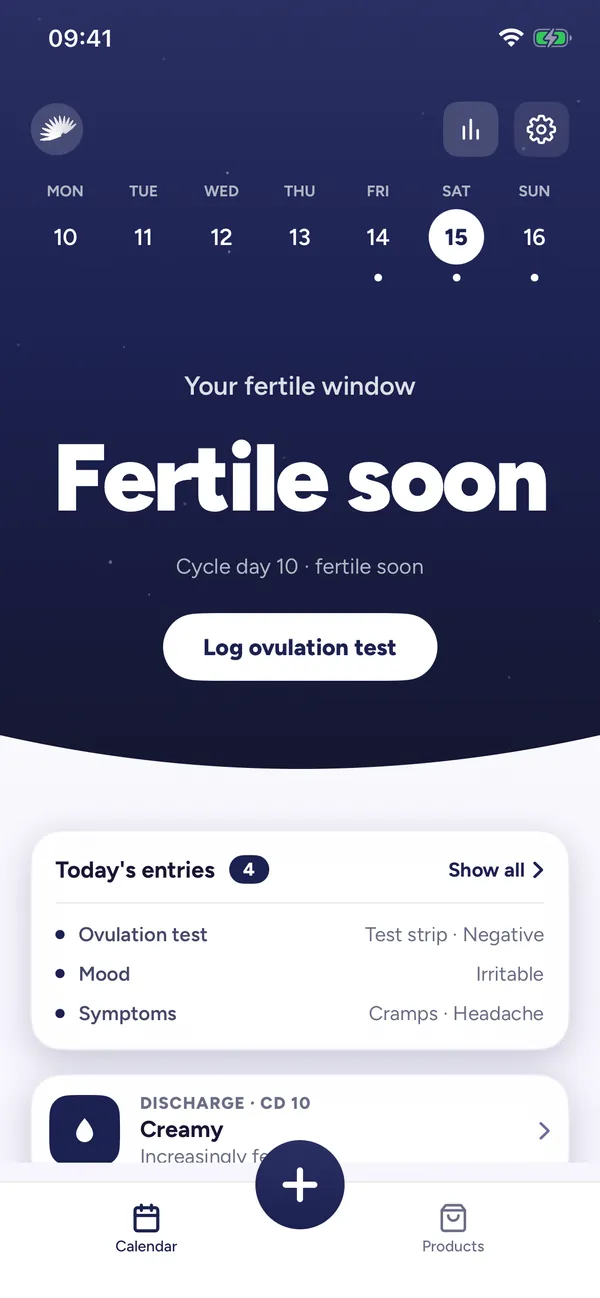
Cyelle does not show ovulation as a fact but as a prediction. The fertile window is calculated from your cycle length and appears as a range of days in the calendar; the ovulation day within it is marked “Prediction: Ovulation day.” For the prediction of your next period, the app states how many cycles it is based on and how reliable it currently is. Once you have recorded three cycles, Cyelle calculates with your own cycle length.
Cyelle usually shows a shorter window than the calculation in this article: it comes from your cycle length, not from the range between your shortest and longest cycle. Both are approximations.
If you enter an ovulation test and confirm a positive result, Cyelle sets the expected ovulation to the following day and aligns the window with it. You read the test yourself, and the app saves your entry, without a photo. In the statistics you see average cycle length, variation and your entered tests per cycle.
Frequently asked questions
How do I calculate ovulation from cycle length?
Count backward: take the shortest and the longest of your recent cycles and subtract 14 days from both. That gives the earliest and the latest calculated ovulation day; for cycles under 27 days, use at least day 12. The calculated window starts five days before the earliest. With cycles of 29 to 33 days, that is cycle day 10 to 19. The calculation gives a prediction with a range and is not suitable for contraception.
Does ovulation always happen 14 days before your period?
No. As a rule of thumb, it is calculated to fall about 14 days before your next period, but in 28-day cycles that was the case in only about 1 in 10 cycles. The time after ovulation lasts about 11 to 13 days on average and varies by about three days from cycle to cycle. Ovulation therefore does not fall on a fixed day but shifts with the cycle.
When is ovulation in a 28-day cycle?
Calculated, around cycle day 14: by the rule of thumb “length minus 14,” ovulation falls about 14 days before your next period. It was most often on day 15, and the spread was at least ten days, about five days in either direction around day 15.
When is ovulation in a 26-, 30- or 35-day cycle?
At 30 days the rule of thumb gives cycle day 16 and the average is about day 15. At 26 days it is day 12 and about day 15, at 35 days day 21 and about day 19–20. On top of each value comes a spread of about four to five days in either direction. The averages apply to groups of cycle lengths, not to you personally.
How do I calculate ovulation with irregular periods?
Calculate with the shortest and the longest of your recent cycles. The more the length varies, the wider the range: with 29 to 33 days it is cycle day 10 to 19, with 24 to 45 days day 7 to 31. With very irregular cycles the calendar calculation says little; ovulation tests and observing other signs then help more.
How long does the luteal phase last?
In textbooks it is 14 days. On average it is about 11 to 13 days depending on the dataset, and most cycles fall between about 7 and 17 days. In the same woman it varies by about three days from cycle to cycle.
Can ovulation shift from cycle to cycle?
Yes. Ovulation can shift by a few days from cycle to cycle, even for no obvious reason. If it is later, the period comes later too, because the time afterward stays about the same. That is why the calculation is only an approximation and gives a window of days.
Can you calculate ovulation exactly?
No, only as a window of days. Even at the same cycle length, ovulation varies over several days, at 28 days over at least ten. A calculation therefore gives a prediction with a range, not a day you can rely on. It is also not suitable for contraception.
When to see a doctor?
Get help right away (information for the US):
- Dizziness or fainting: call 911 (or your local emergency number) right away.
- Severe one-sided lower abdominal pain, or pain that spreads to the shoulder: go to the ER right away. If you feel faint or can’t get there safely, call 911 (or your local emergency number).
- Very heavy bleeding: go to the ER right away.
- Fever together with severe lower abdominal pain: go to the ER right away.
- Your pregnancy test is positive or your period is late, and you also have severe or one-sided pain: go to the ER right away. If you feel faint or can’t get there safely, call 911 (or your local emergency number).
- Your pregnancy test is positive or your period is late, and you are bleeding, even lightly: have this checked by a doctor right away. Call your ob-gyn’s office or another health care provider today. If the office is closed, call anyway: most practices have an after-hours line or an on-call provider. If you can’t reach anyone, go to the ER.
- One-sided lower abdominal pain does not ease after a few hours or gets worse: call your ob-gyn’s office or your primary care provider today. If the office is closed, call anyway: most practices have an after-hours line or an on-call provider. If you can’t reach anyone, go to the ER.
It is best to have this checked by a doctor:
- Your period doesn’t come for more than three months and a pregnancy test is negative (while breastfeeding, that is to be expected).
- You have bleeding between periods in several cycles.
- Your cycle length is repeatedly under 21 or over 38 days; your cycle data are a good basis for the appointment.
- You want to get pregnant and it has not happened after about a year; from about age 35 or with very irregular periods, sooner.
For orientation only — no substitute for medical advice or diagnosis.
All values are calculations. Cyelle is not a contraceptive and does not provide diagnoses.