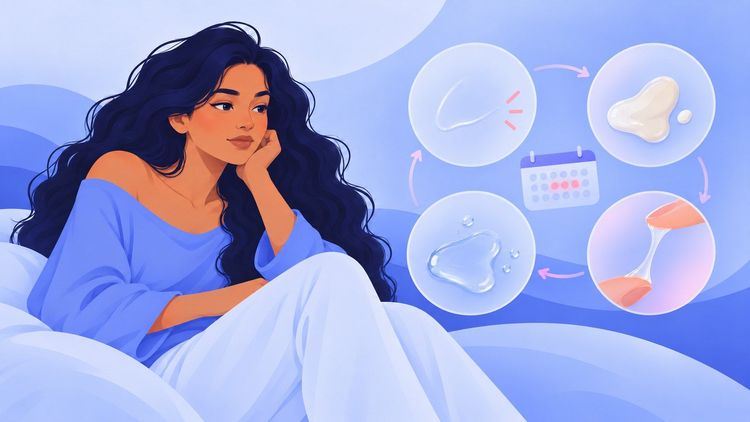
Signs of ovulation include changes in cervical mucus, a one-sided twinge or ache in the lower abdomen (ovulation pain, or mittelschmerz), a higher libido and, only in hindsight, a rise in basal body temperature. Some women notice them, many notice nothing, and both are common.
No single body sign shows on its own that ovulation has happened or when.
At a glance
- Twinges usually last
- 3–12 hrs
- Temperature rise
- 0.4–0.7 °F
- Range in 28-day cycles
- 10 days
- Egg can be fertilized
- 12–24 hrs
Can you feel ovulation?
Some women can feel their ovulation, many can’t. Plenty of women are familiar with ovulation pain (mittelschmerz), a one-sided twinge or dull ache in the lower abdomen around the middle of the cycle; if you get it, you often notice it nearly every month.
Five signs of ovulation are mentioned most often: changes in cervical mucus, a twinge or ache in the lower abdomen, a higher libido, a different mood and, visible only in hindsight, a rise in temperature. The mucus depends on the hormone estrogen, the temperature rise on the hormone progesterone, which is only produced after ovulation. So what you notice are side effects of a process you can’t see from the outside.
That’s why missing signs say nothing about whether ovulation has happened, and signs that are there don’t prove it. For a pregnancy, what matters is ovulation, not whether you notice it.
Why ask about ovulation at all? The egg can be fertilized for only about 12–24 hours, while sperm can survive in the body for several days, usually 3–5. A pregnancy is therefore most likely in the days before ovulation and on the day of ovulation. The calculated fertile window covers about six days and ends on the predicted day of ovulation; with a confirmed positive test, it runs one day longer. It is an approximation, not a date, and a pregnancy is possible outside of it too, because ovulation can come earlier or later than calculated.
Neither this calculation nor watching body signs is suitable for contraception: ovulation shifts from cycle to cycle, and signs can be missing or misleading. If you don’t want to get pregnant, talk to your ob-gyn’s office or a family planning clinic.
Why day 14 is often wrong
Cycle day 1 is the first day of your period. For many women, ovulation happens about 14 days before the next period. That’s a rule of thumb, not a date: even in 28-day cycles, ovulation is spread over about ten days, and only in about 1 in 10 of these cycles did it fall exactly 14 days before the period. “Ovulation is always on day 14” is therefore a myth.
What matters is your cycle length. The time between ovulation and the next period is the steadier part; the time before it varies. In a 35-day cycle, ovulation falls on average closer to cycle day 20 than to day 14, in a 24-day cycle closer to day 12; both values are approximations with a spread of several days.
Cycle and pregnancy in one app.
Cyelle accompanies your cycle, your wish to conceive and your pregnancy. You decide at any time which module fits right now.


Try it free for 3 days. Then a monthly or yearly subscription, both modules included.
Cervical mucus at ovulation
Egg-white, stretchy cervical mucus is a sign many women observe. Cervical mucus is the fluid from the cervix that you may notice as discharge on your underwear or when you wipe. “Egg white” means: like raw egg white, clear, and so stretchy that you can pull it into strands between two fingers. It changes over the course of the cycle: after your period there is often little or nothing to see, then it turns moist and creamy, around mid-cycle clear, thin and stretchy, and afterward tacky and cloudy again. This happens over several days, and the shift over time matters more than any single day.
The peak, the last day with clear, stretchy mucus, is only known in hindsight, because only the following day shows that it was the last. For most women, the peak falls at most three days before or after the surge of the hormone LH (luteinizing hormone), which triggers ovulation. So the mucus points to a period of time around ovulation, not to a single day. Little mucus says nothing about whether ovulation is happening. Here’s how to observe it:
- Check at the same time each day, for example in the evening, and after the cycle look at the pattern, not at single days.
- Describe in words what you see: nothing, moist, creamy, watery or egg white.
- Blood, semen, lubricant or irritated skin change the picture. If that happens, that day’s observation isn’t usable, and “nothing noticeable” is a valid entry.
If you notice that discharge looks distinctly yellow, green, gray or foamy, is white and crumbly like cottage cheese, smells strong or fishy, itches, burns or feels sore, if you have pain when urinating, or if there is bleeding after sex, it’s best to have that checked by a doctor. If a fever or very severe lower abdominal pain comes with it, the box at the end applies: get medical help right away.
Watch the pattern across the cycle, not the single day.
Ovulation pain and twinges
Ovulation pain, known medically as mittelschmerz, is a one-sided twinge, ache or sharp pinch in the lower abdomen around the middle of the cycle. It usually fades after hours, typically after 3 to 12, sometimes not until up to two days later. It can occur shortly before ovulation, around it or shortly after, and many women don’t have it.
It is described as a tugging or twinging feeling, a dull pressure or a brief sharp stab, sometimes with nausea or pain in the lower back. Some women report light, brief spotting, brown or pink. If it gets heavier, lasts longer or keeps coming back, it’s best to have it checked by a doctor. The side can switch or stay the same, and it doesn’t tell you whether ovulation is happening.
Some women find warmth, such as a heating pad, and rest soothing as long as the twinge stays mild. Whether a pain reliever is suitable is something to ask a pharmacist or your ob-gyn’s office; tell them if you want to get pregnant or could be pregnant, because not every medicine is suitable then.
A pulling sensation, tightness or bloating in the days after the suspected ovulation can occur and can’t be reliably interpreted. Whether you are pregnant is shown by a pregnancy test, not by how your body feels. About twelve days after ovulation, a standard test is often still negative; if you miss your period, repeat a negative test after a few days.
Not every pain in the middle of the cycle is mittelschmerz. Very severe or worsening pain, or pain with fever, dizziness or fainting: don’t wait, get medical help right away, even if you don’t expect to be pregnant. You’ll find more in the box at the end. To log it, side, duration and severity are enough.
How to read an ovulation test
An ovulation test is a second observation, not a substitute. It shows the LH surge in your urine, not that ovulation has already happened: a positive test shows LH, not an egg. Ovulation usually follows the surge after 12–36 hours, in rare cases up to about two days later. A test is also not suitable for contraception.
With classic strips, the test line counts as positive when it is at least as dark as the control line, the line that shows the test is working. That’s a manufacturer convention, not a medical limit, and a line that is almost as dark remains a negative result. If the control line is missing, the test is invalid. Read the result after the time given in the package insert, often 5 to 10 minutes; anything that darkens later doesn’t count.
When you start depends on your cycle length: with classic strips, most people start around cycle day 9 in a 28-day cycle, around day 14 with 35 days. The chart for your test is in the package insert; with short or irregular cycles people tend to start earlier, and with very long cycles there can be many test days without a surge. The time of day also differs by test. Classic strips are usually used during the day, not with first morning urine; the package insert often says about 10 a.m. to 8 p.m. and to limit fluids in the hours before. With Clearblue pink, any time of day works, but at about the same time each day, and no urinating for at least 4 hours beforehand. Clearblue purple specifies first morning urine. Drinking a lot dilutes your urine.
A negative test doesn’t rule out a surge: test strips miss roughly a quarter to a third of surges, and in about 3 in 10 cycles there is an earlier surge before the actual one that isn’t followed by ovulation. The more days in a row you test, the more likely a surge is noticed; whether a second test in a day makes sense is in the package insert. For many women, LH rises over two to six days: the line gets darker, reaches a peak and gets lighter again, which is normal, not an error.
Pregnancy, the menopause transition and medicines that contain LH or hCG can distort the result; the manufacturers list them as factors that can interfere with the test. With very irregular cycles, tests are harder to read. If no surge shows up despite daily testing over about three cycles, talk to your ob-gyn’s office about it.
Cycle and pregnancy in one app.
Cyelle accompanies your cycle, your wish to conceive and your pregnancy. You decide at any time which module fits right now.
Try it free for 3 days. Then a monthly or yearly subscription, both modules included.
Digital tests: the symbols
Digital tests show symbols instead of lines. You can tell which test you have by the box: Clearblue purple is the Advanced test, Clearblue pink the Digital test.
- Clearblue purple: The empty circle means no rise. The flashing smiley shows a rise in estrogen, not in LH. The static smiley shows the LH surge and stays displayed for about 48 hours.
- Clearblue pink: empty circle, no LH surge; static smiley, LH surge. There is no flashing smiley here.
The purple test starts earlier in the cycle than classic strips; the chart is in the package insert. Several days in a row with a flashing smiley are possible before the static smiley appears; in a small share of cycles it doesn’t appear at all, which is not a defect of the test. With Clearblue pink, the result stays on the display for about 8 minutes. If you missed it, it still shows for about 2 minutes after you take the test stick out. The symbols describe what the test shows, not how fertile you are, and they are not suitable for contraception.
Test in your hand?
Here’s how to log what you see:
- Test line lighter than the control line: negative.
- Test line almost as dark: negative. Test again later according to the package insert or the next day, and log every test with the time.
- Test line at least as dark as the control line: positive (manufacturer convention, not a medical limit). This shows the LH surge; ovulation usually follows after 12–36 hours.
- Flashing smiley: estrogen, not LH. Log it as a flashing smiley.
- No control line: test invalid, repeat it.
Real-life examples
Strip negative, but egg-white mucus. Log both: the mucus under Discharge and the test as negative. They are separate observations: the mucus depends on estrogen, while the strip shows the LH surge. How often a day you test is in the package insert.
Twinge on one side, strip negative. Log the twinge under Symptoms, for example as Cramps, and the test as negative. The twinge can come shortly before ovulation, around it or shortly after; the strip shows only LH.
Test line almost as dark as the control line. You read the test line yourself, use a slider to set how dark it looks next to the control line, and enter what the test shows, without a photo. A line that is almost as dark stays a negative result. If you test again later, log it as its own entry with the time. That way you can see whether the line was lighter in the morning and darker in the evening.
Test positive. You log the result as positive. If you confirm a positive result, the app sets the predicted ovulation to the following day and aligns the calculated window with it; the window then runs one day longer. Several positive days in a row belong to the same surge. This is a calculation, not a statement of whether and when ovulation happens.
Two signs that disagree are two observations, not a mistake.
Libido, mood, sore breasts
Many women report that libido (sex drive) and mood change across the cycle: some feel irritable, tearful or down, others upbeat. The evidence is mixed: libido can’t be tied to a fixed phase in which it is higher or lower, and both libido and mood depend on sleep, stress, relationships and some medicines. There is no reliable finding that links a particular mood to the middle of the cycle; the time before the period, when mood changes in some women, is better documented. If it weighs on you heavily or limits your daily life, talk to your ob-gyn’s office about it.
Breast tenderness usually starts only after ovulation, so it isn’t useful as an early sign. Digestive symptoms tend to occur in the second half of the cycle. Women also mention bloating, nausea, headaches, tiredness, cravings or a keener sense of smell; for none of these is a reliable link to ovulation documented. Log them under Symptoms, Mood or Digestion, and after several cycles you’ll see whether they fall on similar days for you.
Cycle and pregnancy in one app.
Cyelle accompanies your cycle, your wish to conceive and your pregnancy. You decide at any time which module fits right now.
Try it free for 3 days. Then a monthly or yearly subscription, both modules included.
Basal body temperature (BBT)
After ovulation, your resting body temperature, the basal body temperature (BBT), rises by about 0.4–0.7 °F (0.2–0.4 °C) and stays raised until the next period. The trigger is the hormone progesterone. Which values you have differs from woman to woman; what counts is the jump in your own pattern, not a fixed number such as 98.6 °F (37 °C). Measure in the morning after waking and before getting up, at the same site (mouth, vagina or rectum) and with the same thermometer; how long to measure is in its instructions.
The chart helps you in hindsight: if it stays raised for several days, that suggests, looking back, that ovulation has happened. It can’t prove it. The catch: the rise shows only after ovulation, in part up to three days after, and by the time you see it, ovulation is usually already over. The chart is therefore no use for prediction and poor for pinpointing the day of ovulation as well: the day of the rise matched the LH surge to within a day in only about 2 of 10 cycles. A drop before ovulation (sometimes called an “ovulation dip”) is not consistent.
An example: ten days of readings around 97.5 °F (36.4 °C), then 12 days around 98.1 °F (36.7 °C). Looking back, the jump fits an ovulation in the days before; it doesn’t reveal the exact day. A single high reading is not ovulation, and a missing rise can’t be interpreted. These things change the readings:
- Fever or a cold
- Alcohol the evening before
- Stress, lack of sleep or shift work
- Time zone changes
- Medicines, and starting or stopping the pill
- Measuring much later than usual
The temperature chart sorts things out in hindsight; it can’t predict anything.
Reading the signs together
Several signs of ovulation together give a better picture than one alone, especially across several cycles, because each sign has its own weakness. Even then it remains an observation. An example: you see egg-white mucus, feel a twinge on the right and have a higher libido than usual. These are signs that many women report around the middle of the cycle. For you, they say nothing about whether ovulation is still ahead, happening right now, already over or happening at all.
Which sign says the most? None on its own. Neither calendar calculation nor mucus, temperature, body signs or ovulation tests are suitable for contraception.
Logging ovulation signs
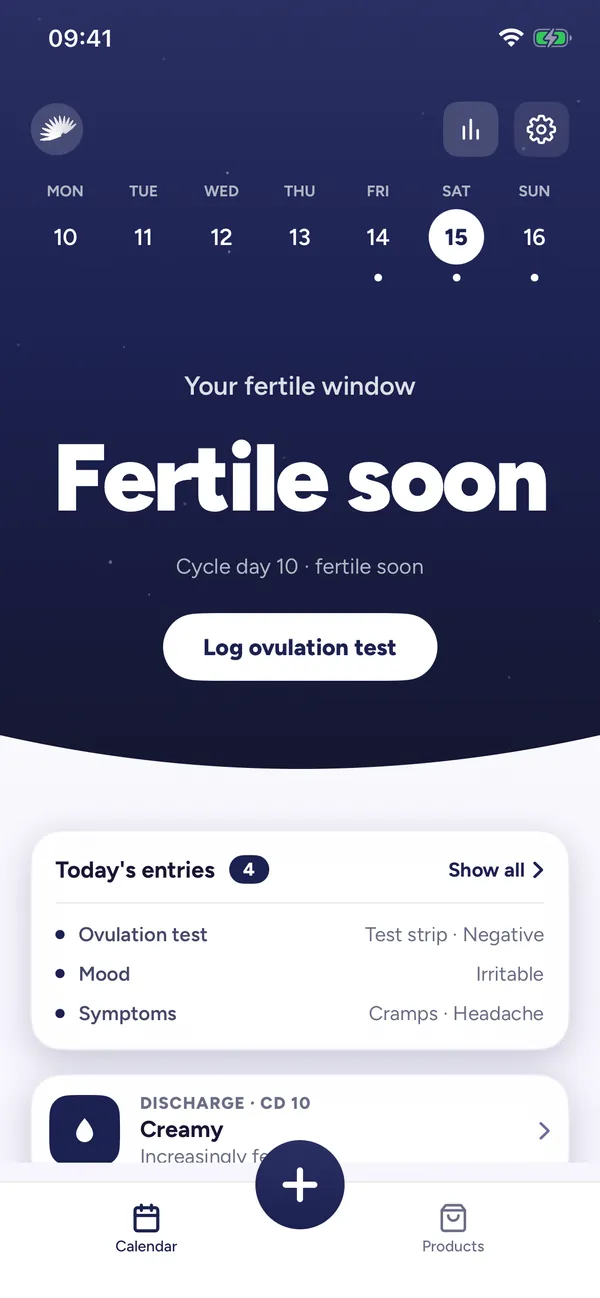
You log signs of ovulation in Cyelle yourself; the app doesn’t evaluate them. Cyelle calculates your period, fertile window and ovulation from your cycle and shows them as a prediction; the day of ovulation within it is marked as a prediction. At a minimum, logging your period and tests is enough; everything else is optional.
- Discharge: Choose Dry or one of the eight drawn types, from Milky white and Egg white through Brown, Pink and Yellow to White & clumpy, Green and Grey. To learn more, there is a page for each type under “Discharge types”. The pages are not an ovulation test.
- Symptoms, Mood, Digestion, Sex & libido: for example Cramps for a twinge or ache; add side, duration and severity under Notes.
- Temperature: Log your basal temperature; Statistics shows it as a curve.
- Ovulation test: With a test strip, you read the test line yourself and enter what the test shows, without a photo. You log digital tests such as Clearblue purple and pink with their symbols. Several tests a day are possible, each with a time.
You log forgotten days afterward instead of guessing. From three logged cycles on, the app calculates with your own cycle length; next to it you can see how reliable the prediction currently is.
When your cycle varies
If your cycle varies a lot from month to month, ovulation falls somewhere different in every cycle: the time between ovulation and your period is the steadier part, the time before it varies. A long cycle can therefore have a late ovulation or none at all. The calculation is then especially rough: it shows a wide window instead of a point, and alongside it how reliable the prediction currently is. Your entries help you see a pattern across several cycles.
How soon ovulation returns after you stop the pill differs from woman to woman, no matter how long you took it. In some, ovulation returns in the very next cycle, in others it takes a few months. Signs and tests are harder to read in the first cycles. If your period stays away for more than three months, discuss it with a doctor; if a pregnancy is possible, a test shows whether you are pregnant.
After a miscarriage, it can take up to eight weeks for your period to return and a few months for your cycle to settle again. After giving birth and while breastfeeding, your cycle can also be very irregular, and signs are harder to interpret then. You can talk through questions about this with your ob-gyn’s office or a midwife. In the years before menopause, known as perimenopause, ovulation becomes increasingly irregular; there are cycles with and without ovulation.
Cycle and pregnancy in one app.
Cyelle accompanies your cycle, your wish to conceive and your pregnancy. You decide at any time which module fits right now.
Try it free for 3 days. Then a monthly or yearly subscription, both modules included.
Ovulating without symptoms
Ovulating without symptoms is common: many women notice none of the signs, and that says nothing about whether ovulation has happened. You haven’t missed anything or done anything wrong if you notice nothing. A regular period doesn’t prove ovulation either, because there are cycles with bleeding but without ovulation. If you’d like to look for a pattern, you can proceed like this:
- Choose one or two signs that are easy for you to observe, for example mucus and temperature.
- Log them on days when you notice nothing, too, because the empty day is part of the pattern. If you’ve already logged a few cycles, use those; otherwise it takes a few months with long cycles.
- Lay the cycles side by side and see whether the mucus and the temperature rise fall at a similar distance before your next period. Statistics shows you your last six cycles; you do the comparison of the signs yourself.
Read the result as an observation about yourself, not as a prediction for the next cycle. You can also pause observing, because the period is enough for the calculation.
A missing sign is not a mistake and not something you failed to do.
When to ask for medical advice
If you’ve been trying to get pregnant for a year without success, have it checked by a doctor; from age 35, that applies after just 6 months. That is the usual waiting time with regular sex and no pregnancy. If you have known health conditions, very irregular or absent periods, or you’ve already had several miscarriages, talk to your ob-gyn’s office sooner, without waiting for these timeframes.
Several causes often act together, and they can lie with the woman, the man or both. That’s why both are usually examined. A doctor can determine whether ovulation is happening, with ultrasound and blood tests; body signs can’t do that. Your records, such as test days with times, mucus and temperature chart, help in the conversation. If the waiting weighs on you, it’s okay to talk about it with your doctor’s office. If it all feels like too much, you can call or text 988.
Frequently asked questions
How do you know when you’re ovulating?
Signs of ovulation that some women notice are changes in cervical mucus, a twinge or ache in the lower abdomen, a higher libido, a different mood or, in hindsight, a rise in temperature. Many notice nothing. No single sign shows on its own that ovulation has happened or when.
Can you ovulate without any symptoms?
Yes, that’s common. Many women notice none of the signs, and that says nothing about whether ovulation has happened. For a pregnancy, what matters is ovulation, not whether you notice it.
What does ovulation feel like, and on which side?
Women describe a one-sided twinge, a dull pressure or a brief sharp stab in the lower abdomen, sometimes with nausea or pain in the lower back. It usually fades after 3 to 12 hours. The side can switch or stay the same, and it doesn’t tell you whether ovulation is happening. Many women feel nothing.
How long does ovulation pain last?
It usually fades after hours, typically after 3 to 12, sometimes not until up to two days later. If the pain is severe and lasts longer than a day or your daily life suffers, it’s best to have it checked by a doctor.
What does cervical mucus look like at ovulation?
For many women it becomes clear, thin and stretchy around the middle of the cycle, similar to raw egg white; before and after, it is more creamy or tacky. The change over the cycle matters more than any single day.
Does temperature drop before ovulation?
Some charts show a lower day right before the rise (an “ovulation dip”), but that isn’t consistent. There is no fixed number; what counts is the jump in your own pattern. A single high reading is not ovulation, and the rise shows only after ovulation, in part up to three days later.
Cramping after ovulation: what causes it?
Ovulation pain can occur shortly before ovulation, around it or shortly after, and breast tenderness or bloating are common in the second half of the cycle. A twinge or light bleeding in these days can’t be reliably assigned to a specific process. Whether you are pregnant is shown by a test.
When is an ovulation test positive?
With test strips, when the test line is at least as dark as the control line. That’s a manufacturer convention, not a medical limit. A line that is almost as dark stays negative. How often a day you test is in the package insert.
When to get this checked?
Get medical help right away or go to the emergency room (ER). If you faint, feel very dizzy or weak, or have very heavy bleeding that doesn’t ease, call 911 (or your local emergency number) right away:
- Very severe or worsening lower abdominal pain, so severe that you can’t get through your day.
- Lower abdominal pain with fever.
- Pain with dizziness, fainting or extreme weakness.
- One-sided lower abdominal pain with shoulder pain, dizziness or bleeding, if your period is late, a pregnancy test was positive or a pregnancy is possible for other reasons, even with a negative early test.
- Heavy bleeding after a positive pregnancy test: soaking through a pad in a short time, more than one pad per hour for two hours, or passing large blood clots. Severe pain is another reason to get help right away.
- During fertility treatment with hormones: a rapidly growing belly, severe pain, or nausea with vomiting. Call your fertility clinic right away; if you can’t reach anyone, go to the ER. For sudden, severe shortness of breath, call 911 (or your local emergency number) right away.
- Thoughts of hurting yourself: call or text 988 right away, or call 911 (or your local emergency number).
It’s best to have these checked by a doctor, ideally today: light spotting or light cramping after a positive pregnancy test. Call your ob-gyn’s office; there is usually someone on call after hours. If a midwife is caring for you, you can call her office too.
It’s best to have the following checked by a doctor:
- Severe pain in the middle of the cycle that lasts longer than a day, or pain that disrupts your daily life.
- Spotting that gets heavier, lasts longer or keeps coming back.
- Noticeable bleeding between periods.
- A period that stays away for more than three months, or cycles that are repeatedly shorter than 24 or longer than 38 days.
- Cycles that vary widely over several months.
- Pain when urinating or bleeding after sex.
Call your ob-gyn’s office about it.
For orientation only — no substitute for medical advice or diagnosis.
All values are calculations. Cyelle is not a contraceptive and does not provide diagnoses.