
Cervical mucus is the fluid your cervix makes. After your period there’s usually little or none, or it feels tacky. Then it turns whitish and creamy, around ovulation it becomes clear, slippery and stretchy like raw egg white, and afterward it gets thicker again. You can observe it with very little effort, you don’t have to do anything “right,” and you can stop any time. Observing cervical mucus is not suitable for birth control.
At a glance
- Egg white lasts
- a few days
- You observe it
- from the outside
- Log per day
- one type
What cervical mucus is
Your cervix makes mucus throughout your cycle, but not always the same kind. Its texture follows your hormones. In the first half of the cycle, estrogen rises. The mucus then becomes thinner, clearer and more stretchy. After ovulation, progesterone, the hormone of the second half of the cycle, takes over, and the mucus gets thick, cloudy and less plentiful again. Doctors also call it “cervical fluid.”
The mucus has a job: it helps sperm travel and keeps them alive. In everyday speech, people often just say “discharge.” That isn’t quite the same thing: cervical mucus is the part that follows the cycle. Discharge is the umbrella term for everything the vagina produces, including colors that have nothing to do with the cycle. How much mucus you notice differs from person to person. Some people rarely see anything, others almost always see something.
Cervical mucus by cycle phase
What cervical mucus looks like changes in an order that’s similar for many women. The days are not: they shift with your cycle length, which is why no cycle days are listed here. The words differ a little from system to system. The timeline in Cyelle shows five phases: “Dry,” “Sticky,” “Milky white,” “Egg white” and “Dry again.” Milky white and Egg white each have their own knowledge page.
- Dry. Right after your period, the vaginal opening is often dry or barely moist, and many women feel nothing. During bleeding, mucus can’t be judged.
- Sticky. Next comes a small amount of mucus, whitish to pale yellow, pasty and hardly stretchy.
- Creamy. The amount increases. The mucus looks cloudy and whitish, like lotion or yogurt. It spreads easily but doesn’t form threads. In the Cyelle timeline, this phase is called Milky white.
- Watery and egg white. In the days before ovulation, the mucus becomes wet, slippery and clear to slightly milky. If it’s wet without forming threads, it’s often called watery. If it stretches into threads between two fingers like raw egg white, it’s called egg white or stretchy mucus. Watery is an extra observation before the egg-white mucus, not a phase of its own on the timeline.
- Dry again. After ovulation, for many women it gets thicker, whitish and less plentiful again.
Not every cycle goes through all the phases, and some come up more than once. Egg-white mucus usually lasts only a few days, for some even less, and some women barely notice it.
Mucus around ovulation
In the days before ovulation, the amount of mucus increases, for many women as early as about five to six days before. The mucus becomes wetter, clearer and more stretchy. For many women, the day with the clearest mucus falls shortly before or around ovulation. Ovulation itself can fall before that day, on it or after it. Mucus shows a phase, not a day, and it doesn’t show whether ovulation has already happened.
After ovulation, for many women the mucus gets thicker, cloudier and less plentiful again, usually within a few days. How fast varies. It can’t be pinned down to the day.
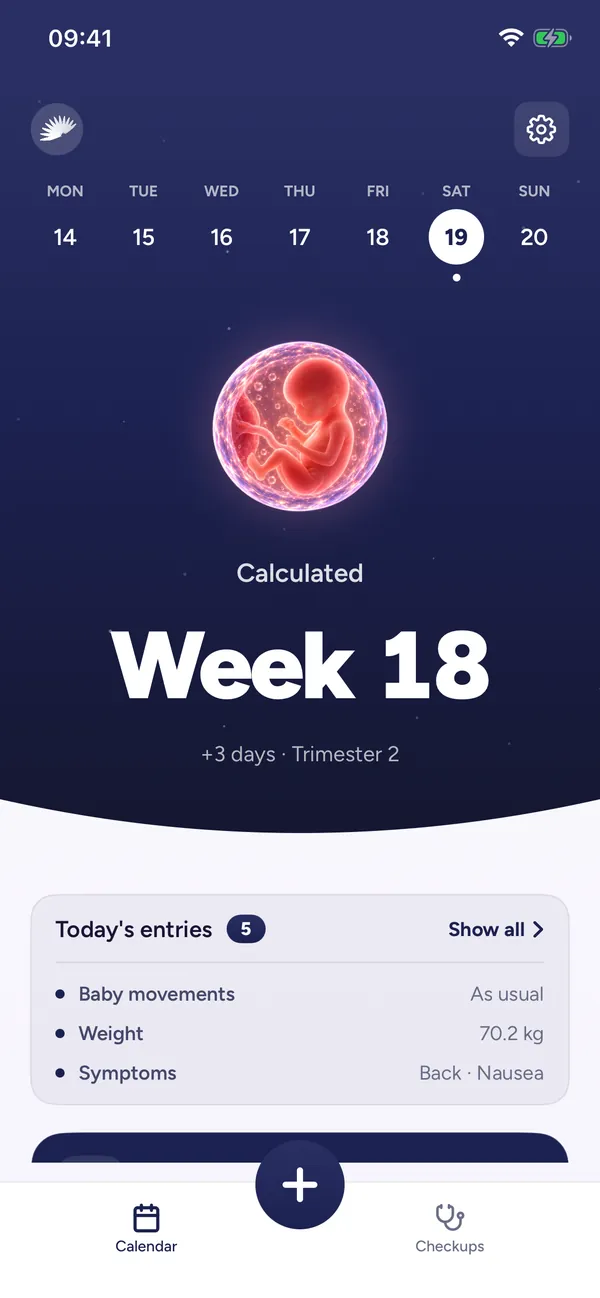
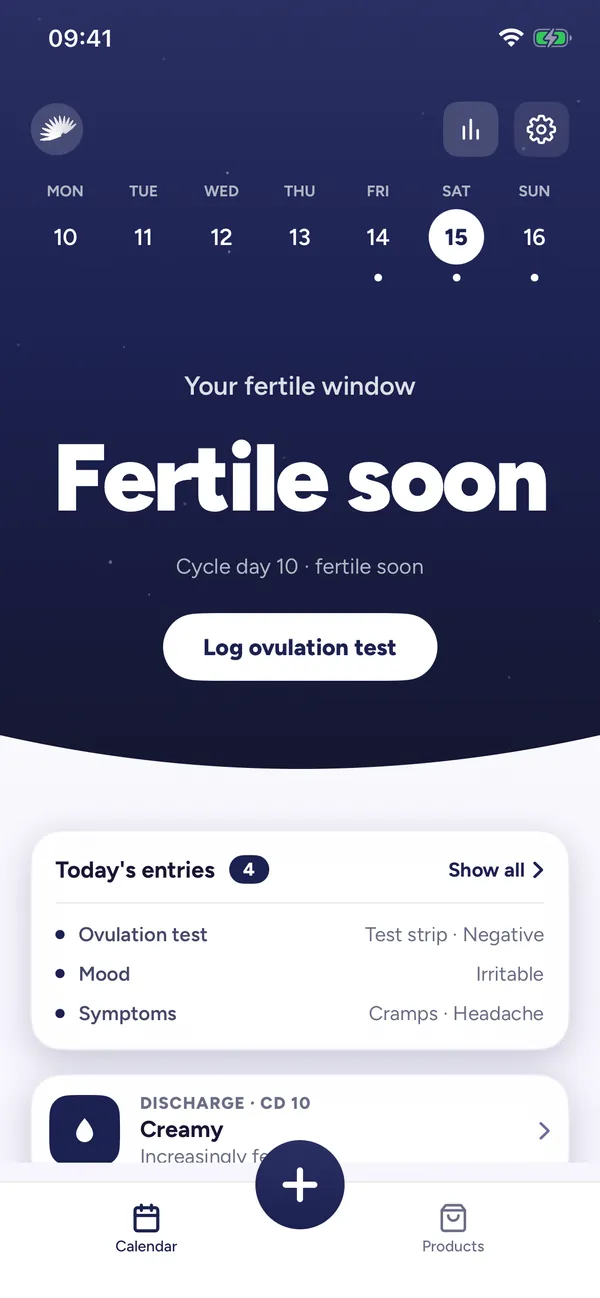
Cycle and pregnancy in one app.
Cyelle accompanies your cycle, your wish to conceive and your pregnancy. You decide at any time which module fits right now.


Try it free for 3 days. Then a monthly or yearly subscription, both modules included.
If your cycle is irregular
Mucus follows your hormone pattern, not the calendar. If your cycle is short, long or changeable, the whole sequence shifts, including in the years before menopause. The wet phase can come later, last longer or build up more than once without ovulation following. Mucus shows the effect of estrogen. It doesn’t show whether ovulation follows.
Cycle days won’t help you much then. Log every day instead, including the dry days: the gaps between the wet phases are part of the picture. With changeable cycles it takes longer for a pattern to show, and sometimes there’s no fixed rule. That’s not something you’re doing wrong. If your cycle length is repeatedly under 24 or over 38 days, or your period stays away for months, it’s worth talking to your ob-gyn.
Look at the pattern over several days, not at a single reading.
How to observe cervical mucus
You don’t need any supplies. A few days of paying attention to how it feels and looks is enough. Many women do it like this:
- Notice the feeling at the vaginal opening during your day: dry, moist, wet or slippery?
- Wipe the vaginal opening with clean toilet paper and look. Your underwear shows something too.
- If you want to know whether it stretches: wash your hands, take a little mucus from the paper or the vaginal opening between your thumb and index finger and slowly pull your fingers apart.
- Take a quick look at different times of day, especially at the beginning.
- In the evening, note the texture you noticed most clearly, not the average of the day.
Observe from the outside. You don’t need to put a finger into the vagina or touch the cervix; the vagina is always moist anyway, which tends to confuse things. Looking from the outside is enough.
After sex, cervical mucus, semen and arousal fluid are hard to tell apart. Lubricant also masks the picture. To keep your pattern readable, it’s best to leave such days blank. A blank day isn’t a mistake, even if it’s one of the days you care about most.
Common stumbling blocks, and what helps:
- You see nothing in the morning but clearly see mucus in the evening: then the clearer reading of the day counts.
- You can’t tell mucus from moisture: pay less attention to the amount and more to whether anything stretches.
- What you see doesn’t match the descriptions: note what you see, not what it should be. Your pattern is allowed to look different.
It often takes several cycles before you see your own pattern. If you’ve been observing for months and see no pattern, that’s not something you’re doing wrong. Observing isn’t a duty: if you can’t manage it every day or don’t want to right now, for example during a stressful time or after a loss, you’re allowed to skip it. This observation is only for getting to know your cycle. It is not suitable for birth control.
How to log it
Choose the type that best fits your observation at the end of the day. If you’re torn between two types, pick the one you noticed more clearly. If you’re unsure, leave the day blank.
Logging cervical mucus
A single look isn’t a pattern yet. Only logging over several days shows how your mucus changes. You can do that on paper, in a spreadsheet or in an app.
In Cyelle, you log it in your daily entry under “Discharge.” There are six types to choose from: Dry, Creamy, Watery, Egg white, Sticky and Spotting. You pick one type per day, based on what you notice. The entry calls the type “Creamy,” while its knowledge page is called “Milky white.” Cyelle saves what you enter and shows it under “My entries,” and you can add missed days afterward.
What you log in the discharge entry doesn’t feed into the predictions for your period and ovulation, not even “Egg white.” An ovulation test is different: if you confirm a positive test, Cyelle sets the predicted ovulation to the following day and aligns the window to it. Spotting is blood, not mucus: if it happens during pregnancy or between periods, see the note at the end.
Cycle and pregnancy in one app.
Cyelle accompanies your cycle, your wish to conceive and your pregnancy. You decide at any time which module fits right now.
Try it free for 3 days. Then a monthly or yearly subscription, both modules included.
What changes your mucus
Hormones control mucus. That’s why anything that affects your hormones also changes how it looks. The most important points at a glance:
Pill and other hormones. Hormonal birth control changes the amount and texture of your mucus, so you often can’t see the pattern you’d have without it. After you stop, your body needs time before its own pattern shows again. How long that takes varies and can’t be given as a number. Ovulation can happen even in the first cycle after stopping. During this time, mucus can turn moist irregularly.
Breastfeeding and after birth. During this time the signs are harder to read, and breastfeeding and the months after birth have their own rules. After birth, lochia, bleeding after delivery, flows for several weeks. It isn’t cervical mucus. Talk about questions on your cycle with your midwife, if you have one, or your ob-gyn’s office.
After a miscarriage or a procedure. After a miscarriage, it can take up to eight weeks for your period to return, and a few months until your cycle is back to how it was. Until then, mucus is often hard to interpret, and that says nothing about you. Procedures on the cervix, such as a LEEP or cone biopsy, can also change mucus production.
Medicines. Some medicines can change the amount and texture, above all hormonal medicines and drugs used in fertility treatment. If you take any, bring your entries to your appointment and bring up changes there. For other medicines, ask your pharmacist.
Menopause. In the years before it, cycles fluctuate more often, and mucus can also decrease or change. Vaginal dryness is one of the well-known symptoms of this time and is hard to tell apart from little mucus. Bring it up with your ob-gyn.
Care products. It’s best to avoid douching, scented soaps and intimate products. Warm water on the outside is enough for washing, plus a mild, unscented soap if needed.
Cycle and pregnancy in one app.
Cyelle accompanies your cycle, your wish to conceive and your pregnancy. You decide at any time which module fits right now.
Try it free for 3 days. Then a monthly or yearly subscription, both modules included.
Little or a lot of mucus
Many women ask whether too little cervical mucus is a sign of no ovulation. That can’t be told from it. Mucus can also build up in cycles where no ovulation follows, and conversely some women notice hardly anything even though their cycle runs regularly. The amount alone says little. It says more when your usual picture changes noticeably, in color or smell, or with symptoms. Then the note at the end applies. If you don’t yet know what’s usual for you, smell, itching, pain and bleeding are what count.
If you have a lot of mucus but no smell or symptoms, that’s part of the cycle for many women. If you notice no change at all over a long time and it bothers you, your ob-gyn’s office is the right place to go.
How much mucus you notice says little on its own.
Mucus and ovulation tests
Stretchy cervical mucus and a negative ovulation test don’t rule each other out. Mucus shows the effect of estrogen, the test shows the rise of LH, a hormone that triggers ovulation. These are two different processes that don’t have to happen on the same day. Often the mucus comes first.
On top of that, a test strip only shows the moment you take it. The LH rise often lasts only a short time, and between two tests it can go unnoticed. A negative test therefore doesn’t rule out ovulation.
Log both side by side instead of playing them off against each other. You read the strip yourself, and when a strip counts as positive is in the package insert. With digital tests such as Clearblue purple and pink, you log the symbol the display shows. A positive test shows an LH rise, not that ovulation has already happened.
What mucus can’t tell you
Egg-white mucus typically appears in the days before ovulation. It says nothing about whether or when a pregnancy will happen. The day with the clearest mucus is only known in hindsight, and even then it often doesn’t fall exactly on the day of the LH rise but usually one to three days off.
Neither tracking your body’s signs nor calculating your cycle is suitable for birth control: ovulation can shift, and sperm can survive for several days. That goes for every method of fertility tracking, including Cyelle. If you want to avoid pregnancy, talk to your ob-gyn or a family planning clinic.
Cycle and pregnancy in one app.
Cyelle accompanies your cycle, your wish to conceive and your pregnancy. You decide at any time which module fits right now.
Try it free for 3 days. Then a monthly or yearly subscription, both modules included.
Mucus when trying to conceive
If you want to get pregnant: cervical mucus describes a cycle phase, it’s not a task or an assignment.
The usual recommendations mention one year: if you’ve been trying regularly to get pregnant for about twelve months, talk to your ob-gyn, and earlier from your mid-30s. That’s no reason to rush, just a guide. If you’re already in treatment, bring your entries along. And if daily checking weighs on you during the wait, you’re allowed to stop, even during treatment cycles.
Mucus before your period
Before your period, cervical mucus is thick, whitish and less plentiful for many women, while for others it stays creamy or plentiful. In early pregnancy, discharge can increase. Both can look similar. That’s why mucus is no sign of pregnancy, neither for nor against: a lot of mucus doesn’t point to pregnancy, and little doesn’t rule it out.
A pregnancy test can tell you whether you’re pregnant and, if you’re unsure, so can your ob-gyn’s office. If you test very early, a test can still be negative even though you’re pregnant. From the day your period is late, it becomes more reliable; with a negative result and lingering uncertainty, repeat it after a few days.
A test shows whether you’re pregnant, not the mucus.
Cervical mucus vs. discharge
Cyelle explains eight types of discharge on illustrated knowledge pages, not photos. Only two of them are called cervical mucus there: Milky white and Egg white. The other six are called discharge, even though in everyday speech “discharge” is the umbrella term for everything. For five of these types, the page also says when in the cycle they can occur.
The timeline shows the five phases of mucus as a guide value for a 28-day cycle. With your cycle, the days can shift. Brown or pink traces contain blood. Many women see them shortly before or after a period; if they show up between periods or after sex, see the note at the end.
Frequently asked questions
What does cervical mucus look like?
It depends on where you are in your cycle: after your period it’s often barely there or sticky, then creamy and whitish, around ovulation clear, slippery and stretchy like raw egg white, and afterward thicker again for many women. The pattern differs from woman to woman.
How long does egg white cervical mucus last?
Usually only a few days, for some less. For many women the amount of mucus increases as early as about five to six days before ovulation. Some women barely notice the egg-white mucus, others notice it clearly. There’s no fixed duration.
What does cervical mucus before a period mean?
On its own, little. Before a period and in early pregnancy, mucus can look similar, so it’s no sign of pregnancy. A lot of mucus doesn’t point to pregnancy, and little doesn’t rule it out. A pregnancy test can tell you whether you’re pregnant and, if you’re unsure, so can your ob-gyn’s office.
How can I tell cervical mucus from semen?
After sex the two are hard to tell apart, and arousal fluid and lubricant also mask the picture. It’s best to leave such days blank so your pattern stays readable.
Why do I have egg white cervical mucus but a negative ovulation test?
That happens. Mucus shows the effect of estrogen, the ovulation test shows the rise of the hormone LH. They don’t have to happen on the same day, and a test strip only shows the moment you take it. You read the strip yourself.
Does having no cervical mucus mean I’m not ovulating?
No, that can’t be concluded from it. How much mucus you notice varies. If you see no change for a long time and it bothers you, talk to your ob-gyn.
How does the pill change cervical mucus?
Hormonal birth control changes the amount and texture of your mucus, and a cyclical pattern is often not visible. How long it takes after stopping for your own pattern to show again varies. Talk about birth control questions with your ob-gyn or a family planning clinic.
How do I observe cervical mucus correctly?
Notice the feeling at the vaginal opening during the day and look with clean toilet paper. In the evening, note what you noticed most clearly, and log the dry days too. It often takes several cycles before your own pattern shows.
When to see a doctor
It’s best to have these checked by a doctor: Call your ob-gyn’s office and make an appointment.
- Discharge that changes noticeably from what’s usual for you, in amount, smell or color (clearly yellow, green or gray), or that becomes frothy or crumbly like cottage cheese.
- Itching, burning, redness or soreness, pain when urinating, or pain in the lower abdomen.
- Bleeding between periods or after sex, even if it happens only once.
- Bleeding more than twelve months after your last period (after menopause).
- Fever along with changed discharge or lower abdominal pain. Outside office hours, call your ob-gyn’s office anyway: there is usually someone on call.
Call 911 (or your local emergency number) right away if discharge or bleeding comes with sudden, very severe lower abdominal pain, with dizziness or fainting, or if the bleeding is very heavy.
If your period is late and bleeding and abdominal pain come with it, get it checked right away, at your ob-gyn’s office or the ER. With very severe pain, pain reaching your shoulder, dizziness or fainting, call 911 (or your local emergency number).
If you’re pregnant, contact your ob-gyn’s office, a midwife or the hospital right away if you have bleeding or if fluid suddenly leaks, as a gush or a constant trickle. After a birth, also contact your ob-gyn’s office, a midwife or the hospital right away if the bleeding suddenly becomes very heavy, large blood clots pass, the discharge smells unpleasant, or a fever comes along with pain in the lower abdomen. After a miscarriage or a D&C, get in touch the same day if you have very heavy bleeding, a fever or foul-smelling discharge.
For orientation only — no substitute for medical advice or diagnosis.
All values are calculations. Cyelle is not a contraceptive and does not provide diagnoses.